| Feature |  |  |
|---|---|---|
| Starting Price | $25/month | $39/month |
| Pricing Model | Freemium | Freemium |
| Free Tier | ||
| Free Trial | 14 days | 10 days |
| Best For | Startups | Startups |
| Tool Type | Best-value |
Frill vs Nolt — Quick Summary
Who each tool is built for, what it does best, and how much effort it takes to get started.
At a Glance
What Each Tool Does
Frill
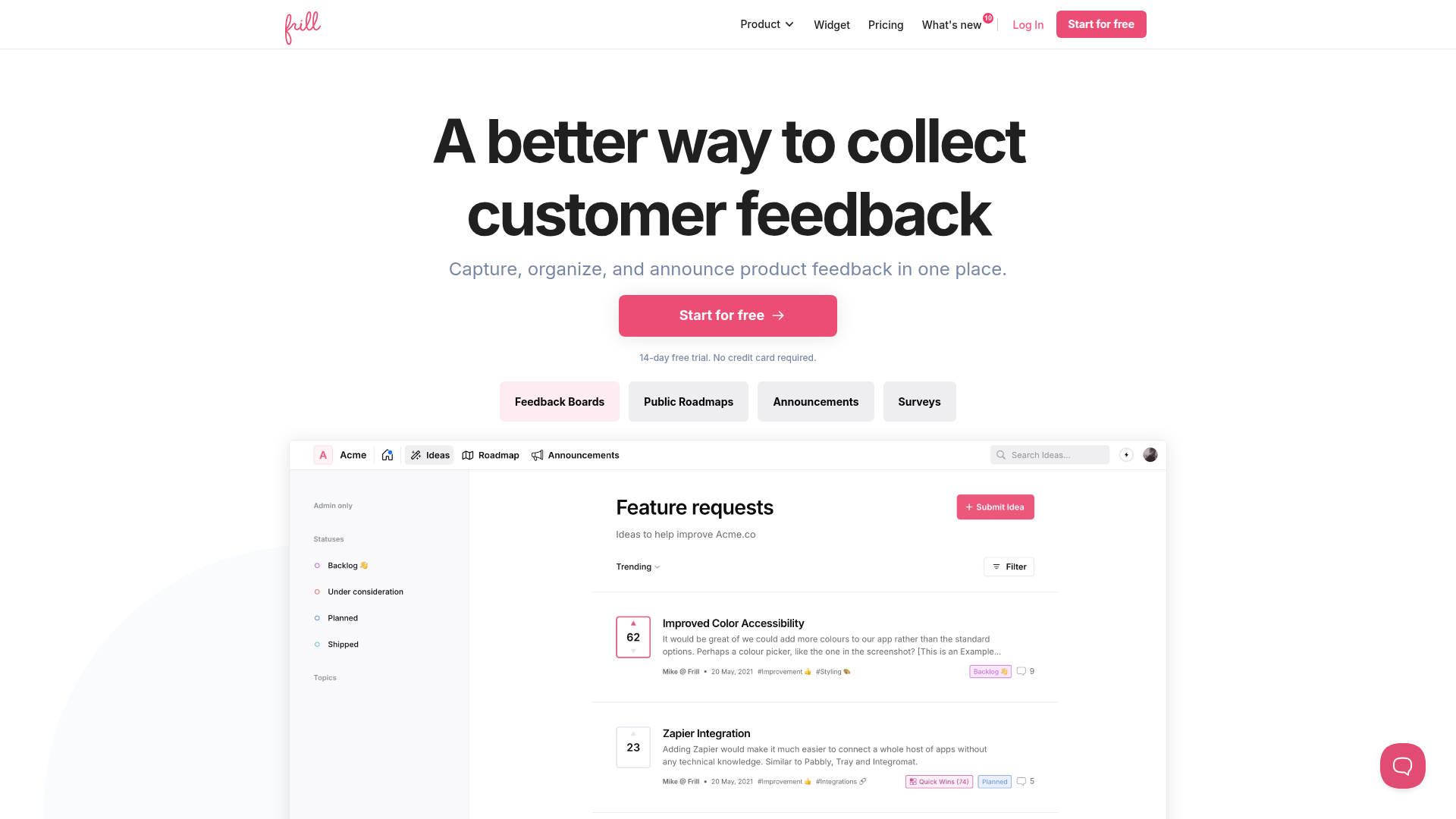
Frill helps you gather and manage customer feedback all in one spot. It's a tool for capturing ideas, building roadmaps, and making announcements.
Standout features:
- •Feedback Boards — organize customer thoughts easily.
- •Public Roadmaps — show users what's coming next.
- •Widgets for your site — gather feedback directly from your site.
Limitations:
- •Might be too detailed for small teams — small teams might not use all features.
- •Requires some learning to set up — tech beginners might need help.
Pricing: Starts with a free trial, subscription plans available.
Nolt
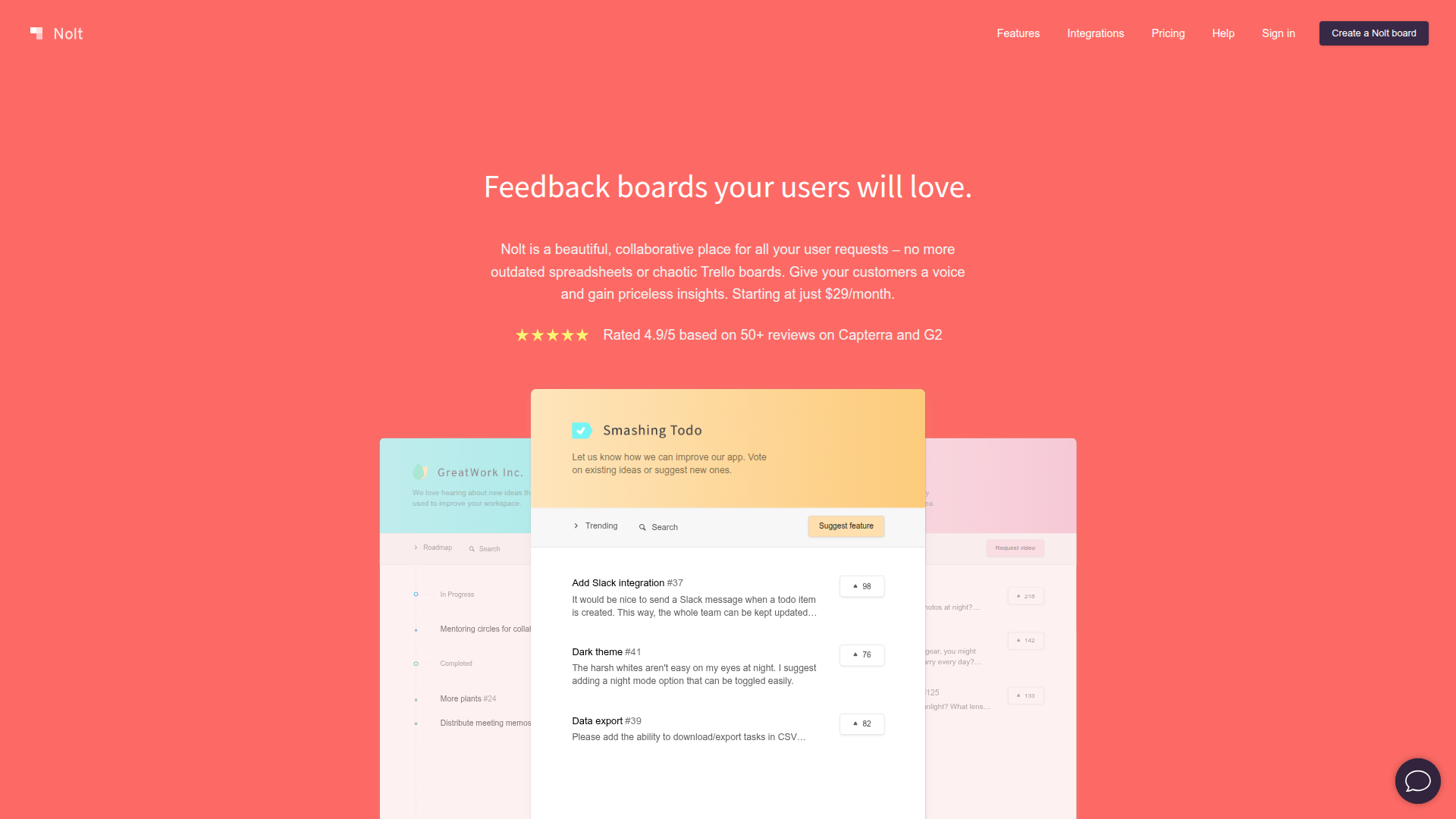
Nolt helps you collect user feedback in one spot. Say goodbye to messy spreadsheets and Trello boards.
Standout features:
- •Simple setup — get feedback fast without hassle.
- •Voting system — know what users want most.
- •Integration options — works well with tools you already use.
Limitations:
- •Paid plans only — might not suit those on a tight budget.
- •Limited to feedback boards — not for those needing more complex project tools.
Pricing: Starts at $29/month.
Growth Hacker Verdict
Frill is your cheat code for justifying feature prioritization to stakeholders — pipe feedback directly in, show voting patterns, watch your roadmap become defensible instead of gut-driven. Best fit: B2B SaaS with 50+ paying customers where you're getting pinged daily about features you're probably not building anyway.
Skip it if you're pre-product-market fit or running a one-person show; the freemium tier exists but you'll outgrow it fast. The real retention play here is using Frill to close the feedback loop publicly — customers see their request implemented and suddenly they're stickier without you doing extra work.
Nolt is the feedback loop you need if your growth strategy depends on turning users into your product roadmap — voting boards + public ideas create real social proof and reduce your support load by surfacing patterns yourself. Skip it if you're still in pre-product-market fit or running a one-person team without the bandwidth to actually act on feedback, because collected-but-ignored ideas kill retention faster than no feedback tool.
The freemium tier is genuinely useful for validation; pair it with Intercom or Slack notifications to close the loop from idea to shipped feature, and you've got a differentiation engine. Best fit is post-launch SaaS with 500+ engaged users who need to kill internal roadmap arguments with actual usage data.
TL;DR — Frill vs Nolt
Choose Frill if you want maximum value for your money — does 80% of what the big names do at a fraction of the cost. Starts at $25/month.
Choose Nolt if you want maximum value for your money — does 80% of what the big names do at a fraction of the cost. Starts at $39/month.
On price alone, Frill wins at $25/month. But cheaper isn't always better — check the feature breakdown above.
When to Choose Frill Over Nolt
Frill is a best-value retention tool built for startups, starting at $25/month. Frill is a tool designed to gather and manage feature requests, enabling teams to prioritize their product roadmap based on customer feedback.
Choose Frill if:
- User feedback + surveys — This is where Frill shines. Strong features at a fraction of enterprise pricing.
- Setup effort: High — There's a meaningful setup investment, but you get more control and customization.
- Pricing starts at $25/month — That's 36% less than Nolt.
- Ideal for: Bootstrapped founders + indie hackers
See all Nolt alternatives or browse the Retention directory.
When to Choose Nolt Over Frill
Nolt is a best-value retention tool built for startups, starting at $39/month. Nolt is a user feedback platform designed to help teams gather and prioritize ideas from their community to enhance product development.
Choose Nolt if:
- User feedback + surveys — Strong features at a fraction of enterprise pricing.
- Setup effort: Low — Quick onboarding with minimal configuration needed.
- Pricing starts at $39/month — Compare what you get at each pricing tier, not just the starting price.
- Ideal for: Bootstrapped founders + indie hackers
See all Frill alternatives or browse the Retention directory.
Frill vs Nolt: Pricing Breakdown
Let's talk money — because that's usually what drives the decision for startups and growth teams.
Frill starts at $25/month with 4 pricing tiers. 14-day free trial available. Priced for startups — won't wreck your runway.
Nolt starts at $39/month with 3 pricing tiers. 10-day free trial available. Startup-friendly pricing.
Our take: Frill is the more affordable option at $25/month vs $39/month. But cheaper isn't always better — compare what you get at each tier before deciding. We always list monthly billing rates — not the discounted annual price that makes everything look cheaper.
FAQ: Frill vs Nolt
Is Frill better than Nolt in 2026?
It depends on your team size, budget, and priorities. Frill is a best-value retention tool built for startups, starting at $25/month. Nolt is a best-value option aimed at startups, starting at $39/month. See the feature comparison above for a detailed side-by-side.
Which is cheaper, Frill or Nolt?
Frill starts at $25/month, while Nolt starts at $39/month. Frill is more affordable on paper. Keep in mind: the cheapest plan isn't always the best deal. Compare what you get at each tier, not just the starting price. We always list monthly billing rates, not discounted annual prices.
Can I use both Frill and Nolt together?
Both are support and customer success tools, so most teams pick one to avoid redundancy and extra costs. That said, some teams use both for different segments or use cases — just make sure the overlap doesn't waste your budget.
Does Frill or Nolt have a free tier?
Neither tool offers a permanent free tier. Frill has a 14-day free trial. Nolt has a 10-day free trial.
How do I switch from Frill to Nolt (or vice versa)?
Most retention tools support data export. Start by exporting your data from your current tool, then check the new tool's import documentation. Many offer migration assistance or onboarding calls to help with the switch.

