Best Intercom Alternatives 2026 | Live Chat & Support Tools
Compare top Intercom alternatives for customer support. Find affordable live chat, help desk, and AI chatbot solutions that cost 50-70% less.

Marco Delvane
Growth Team
Part of our Best Help Desk Software for Startups 2026 guide
Key Takeaways
- Best Overall: Crisp — Free tier that doesn't suck, AI chatbots, and no per-seat pricing trap
- Best for Startups: Tidio — Affordable AI automation without the enterprise bloat
- Best for Scale: Zendesk — When you need serious ticket management and integrations
- Best for Developers: Chatwoot — Open-source with full control and no vendor lock-in
- Intercom's biggest sin: Pricing that punishes growth. Most alternatives cost 50-70% less with similar features
Intercom used to be the obvious choice for customer support. Then they started charging $74/month per seat, making it financially painful to scale your support team. Add their aggressive upsells for basic features and suddenly you're paying $500+/month for what should cost $100.
The good news? The customer support tool landscape has exploded since 2020. You've got solid alternatives with AI chatbots, omnichannel support, and modern APIs that don't require a fintech Series B to afford. Some are open-source. Some have actually generous free tiers. None will make your CFO cry.
This guide covers the best Intercom alternatives in 2026 — from budget-friendly options for bootstrapped startups to enterprise-grade platforms that won't nickel-and-dime you. We've tested the interfaces, compared the pricing, and called out the gotchas so you don't have to.
Quick Comparison: Best Intercom Alternatives
| Tool | Starting Price | Best For | Free Tier? | VGS Verdict |
|---|---|---|---|---|
| Crisp | Free (paid from $25/month) | Small teams wanting AI + live chat | Yes (unlimited) | Best value, generous free plan |
| Tidio | $29/month | Budget-conscious startups | Yes (limited) | Solid automation, fair pricing |
| Zendesk | $55/month per agent | Enterprise needs, complex workflows | Trial only | Powerful but pricey |
| Chatwoot | Free (self-hosted) | Developers, privacy-focused teams | Yes (full features) | Open-source flexibility |
| HubSpot Service Hub | Free (paid from $15/month) | Teams already using HubSpot CRM | Yes (basic features) | Great if you're in ecosystem |
| Freshdesk | Free (paid from $15/month) | Teams needing ticket management | Yes (10 agents) | Reliable, occasionally clunky UI |
| Drift | $2,500/month | B2B sales teams, conversational marketing | No | Sales-first, support-second |
| Help Scout | $20/month per user | Email-focused support teams | Trial only | Clean interface, limited automation |
1. Crisp — Best Overall for Small Teams and Startups
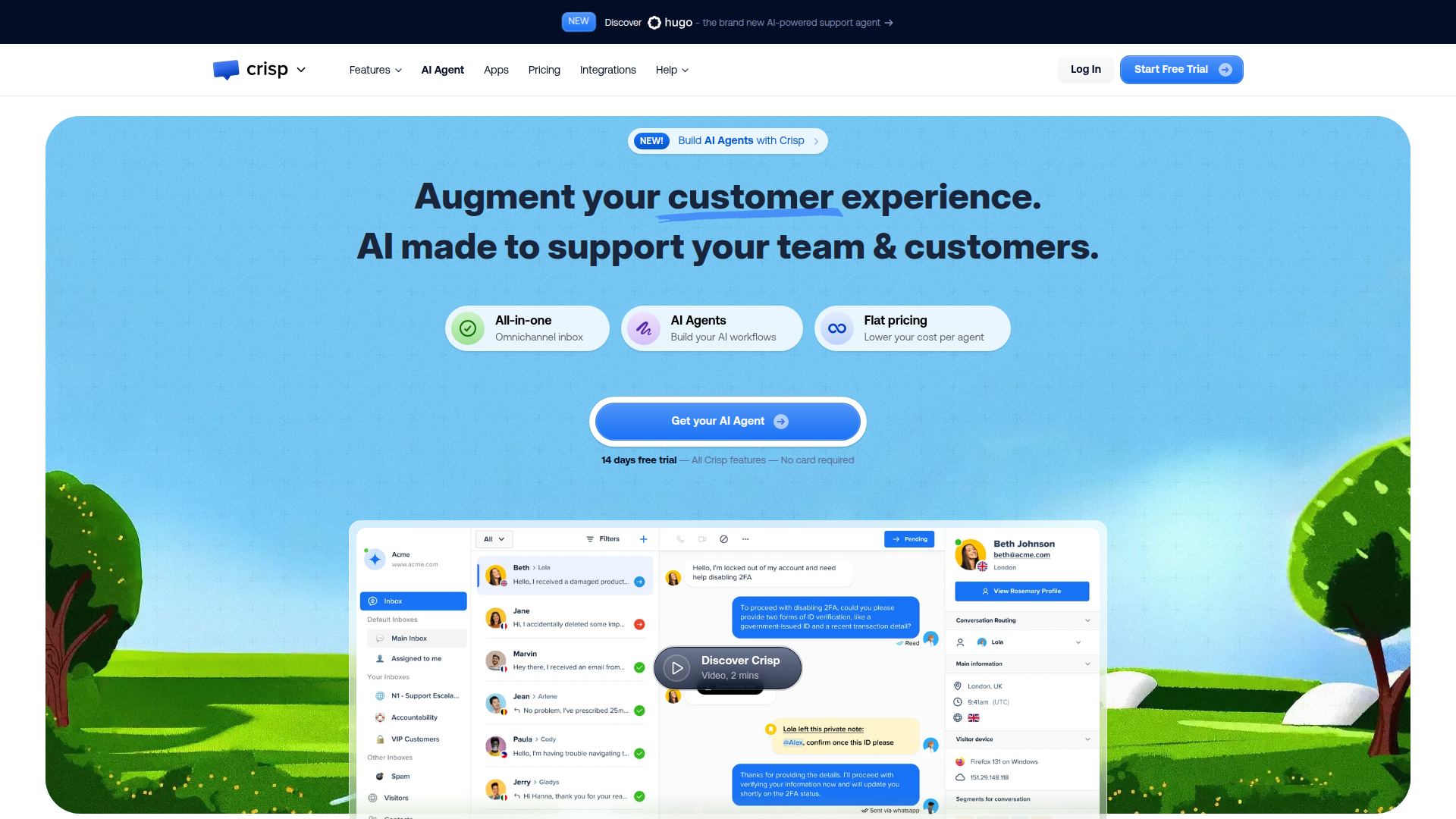
Pricing: Free forever plan available. Paid plans start at $25/month for unlimited agents (yes, really).
Crisp is what Intercom should have been — a clean, modern customer support platform that doesn't treat pricing like a hostage negotiation. The free tier includes unlimited conversations, which is perfect when you're validating product-market fit and can't justify $300/month tools yet.
What sets Crisp apart is the AI layer. You get MagicReply (AI-powered response suggestions) and automated chatbots without paying for a separate "AI add-on" like Intercom forces you to. The shared inbox works across live chat, email, Messenger, Instagram, WhatsApp, and SMS — actual omnichannel support, not just marketing speak.
What We Liked
- Unlimited agents on free plan (most competitors cap at 1-2)
- AI chatbots included, not paywalled
- Co-browsing and screen sharing built-in
- Knowledge base and status page included
What Could Be Better
- Mobile app could be smoother
- Advanced automation requires Pro plan ($25/month)
- Reporting less detailed than Zendesk
Growth Hacker Take: This is our top pick for 90% of startups and indie hackers. The unlimited agent pricing means you can scale your support team without watching your burn rate explode. The AI features actually work, unlike some competitors where "AI" means "automated canned responses."
Crisp Platform Review & Demo
External resources: Crisp Pricing | G2 Reviews (4.5/5)
2. Tidio — Best Budget-Friendly AI Chatbot
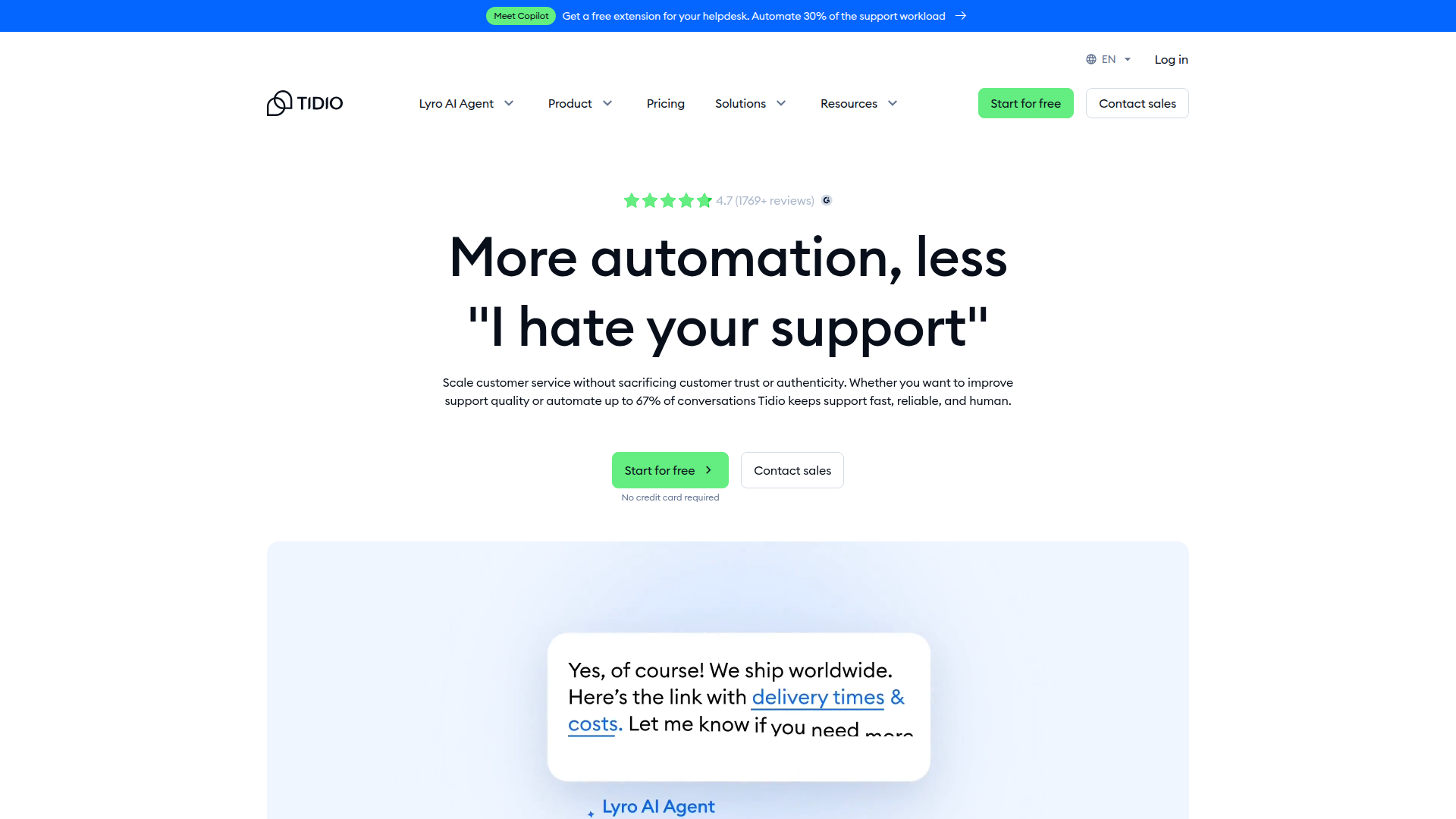
Pricing: Free plan available. Paid plans start at $29/month for AI features and 50 conversations.
Tidio built its reputation on making chatbot automation accessible to non-technical teams. The visual workflow builder actually makes sense (unlike some competitors where you need a computer science degree to set up "if/then" logic). You can automate lead qualification, support triage, and after-hours responses without writing code.
The downside is the conversation limit. The free tier caps at 50 conversations per month, which sounds fine until you realize a single customer asking three questions counts as three conversations. Budget accordingly.
What We Liked
- Visual chatbot builder that doesn't suck
- AI responds in 30+ languages automatically
- Email and live chat in one inbox
- Shopify integration is seamless
What Could Be Better
- Conversation limits can sneak up on you
- Mobile app has occasional lag
- Knowledge base requires higher-tier plan
Growth Hacker Take: Perfect if you're running an e-commerce store or SaaS with predictable support volume. The chatbot templates for abandoned cart recovery and product recommendations are actually useful, not just demo fluff. Just watch those conversation limits — they charge $29 per additional 50 conversations.
External resources: Tidio Pricing | Capterra Reviews (4.7/5)
3. Zendesk — Best for Enterprise and Complex Workflows
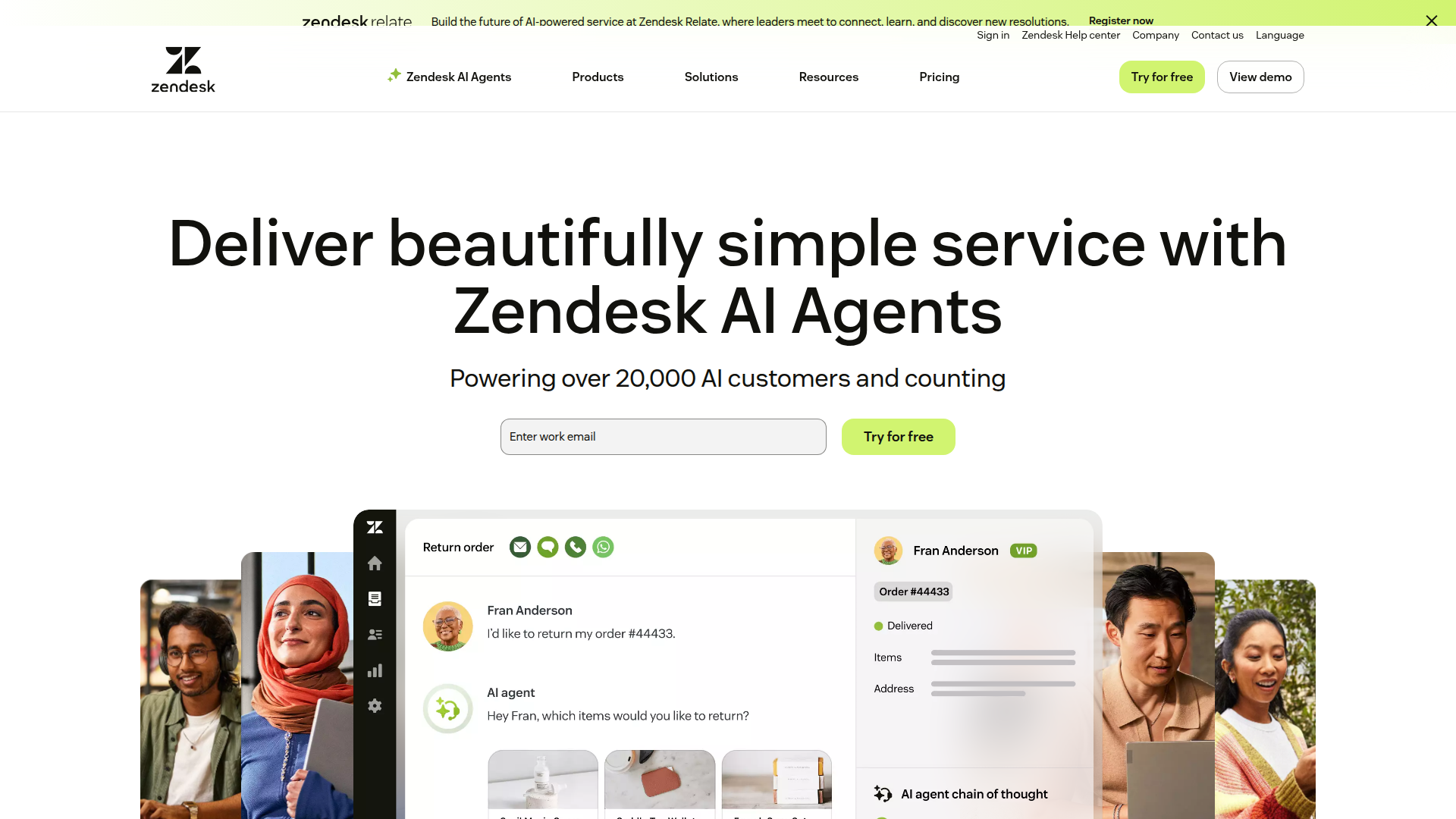
Pricing: Starts at $55/month per agent for Suite Team. Enterprise features start at $115/month per agent.
Zendesk is the 800-pound gorilla of help desk software. It's been around since 2007, which means it's mature, stable, and occasionally feels like software from 2007. But if you need advanced ticket routing, custom SLA policies, multilingual support, and integrations with literally everything — Zendesk delivers.
The pricing is significantly higher than alternatives, but you get what you pay for: rock-solid uptime, comprehensive reporting, and a marketplace with 1,500+ apps. This is overkill for most startups, but the right choice once you're managing 1,000+ tickets per month.
What We Liked
- Incredibly robust ticketing system
- Advanced automation and routing rules
- Best-in-class reporting and analytics
- Integrates with everything (Salesforce, Slack, JIRA, etc.)
What Could Be Better
- Expensive — easily $500+/month for small teams
- Steep learning curve for admins
- Interface feels dated compared to newer tools
Growth Hacker Take: Don't use Zendesk until you actually need Zendesk. If you're a 3-person startup, you're paying for features you won't use for 2+ years. But if you're scaling past 10 support agents or managing enterprise SLAs, this is the safe choice that won't break at scale.
Zendesk Complete Overview
External resources: Zendesk Pricing | G2 Reviews (4.3/5)
4. Chatwoot — Best Open-Source Alternative
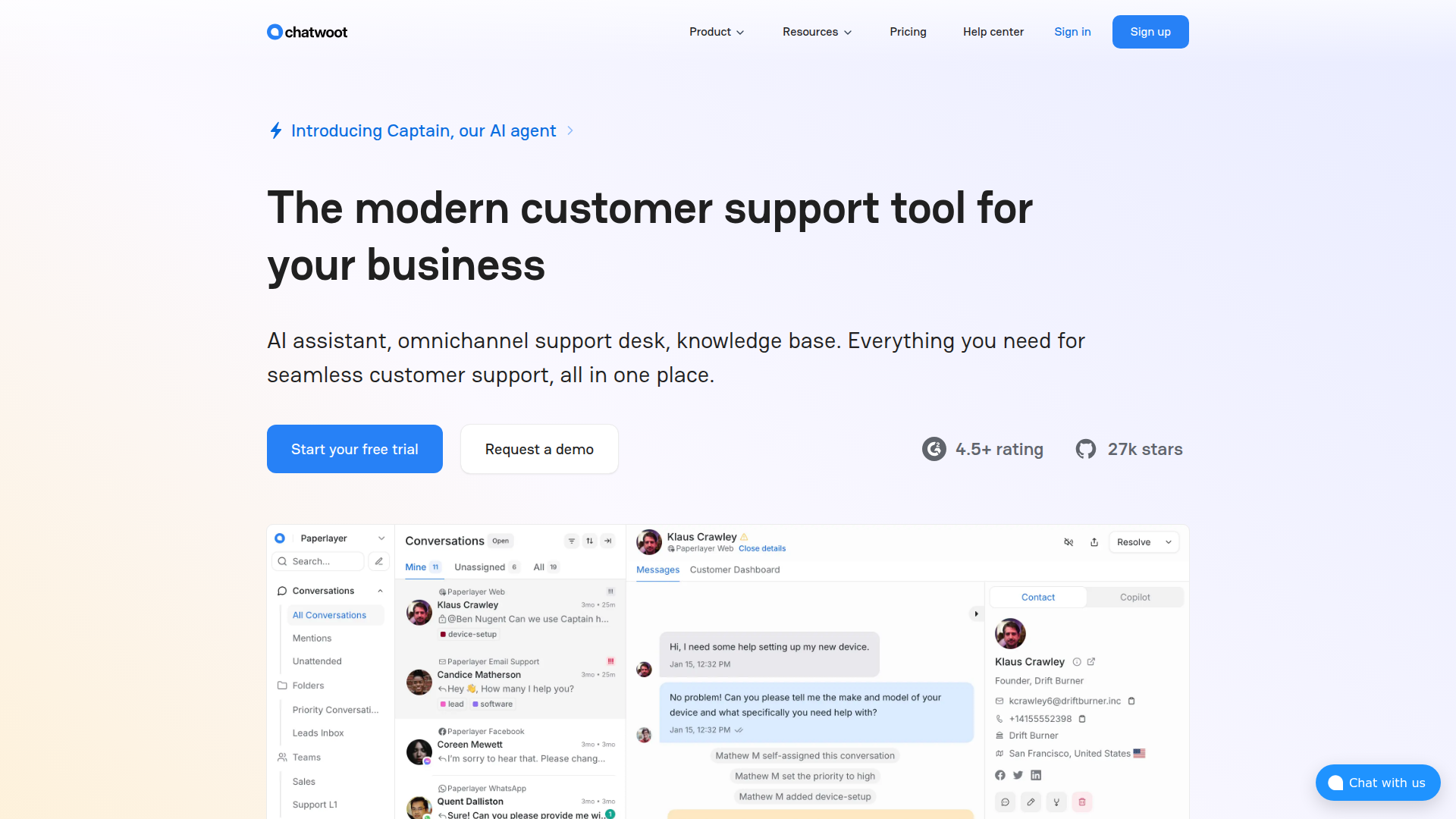
Pricing: Free (self-hosted). Cloud hosting starts at $19/month for up to 10 agents.
Chatwoot is for teams who want full control over their customer data and infrastructure. It's open-source, MIT-licensed, and you can self-host it on your own servers for zero recurring costs. The codebase is clean, actively maintained, and has a solid developer community on GitHub.
The trade-off is obvious: you need technical chops (or a developer on your team) to deploy and maintain it. But if you're in a regulated industry, serving privacy-conscious customers, or just allergic to vendor lock-in, Chatwoot is your best bet.
What We Liked
- Fully open-source with no feature paywalls
- Self-hosted option for complete data control
- Active development community (6,000+ GitHub stars)
- WhatsApp, Telegram, SMS integrations included
What Could Be Better
- Requires technical setup if self-hosting
- UI less polished than commercial alternatives
- Fewer third-party integrations than Zendesk
Growth Hacker Take: Hidden gem for developer-friendly teams. The cloud-hosted option is reasonably priced if you don't want to manage infrastructure, but the real value is self-hosting. Deploy it on a $10/month VPS and you've got unlimited agents forever. No per-seat pricing games.
External resources: Chatwoot Pricing | GitHub Repository
5. HubSpot Service Hub — Best for CRM Integration
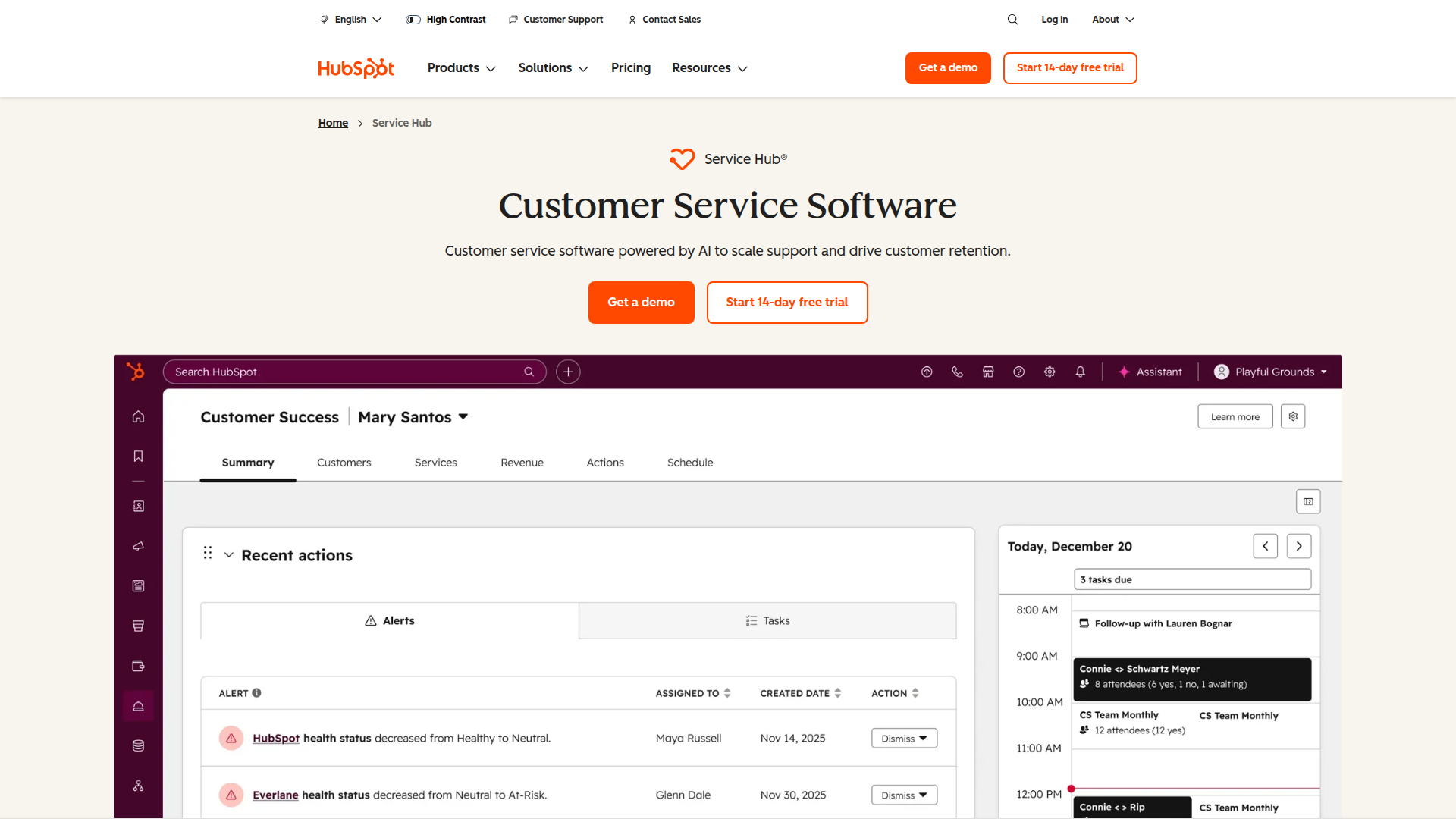
Pricing: Free tier available. Paid plans start at $15/month per seat (Starter) or $450/month for 5 seats (Professional).
If you're already using HubSpot for marketing or sales, Service Hub is the no-brainer choice. All your customer data lives in one place — support tickets automatically connect to CRM records, and your support team can see the full customer journey without switching tools.
The free tier is surprisingly functional: ticketing system, live chat, and basic email automation. The paid tiers unlock conversation routing, customer feedback surveys, and playbooks for common support scenarios. Pricing jumps significantly at the Professional level ($450/month), but you're getting the full CRM integration at that point.
What We Liked
- Seamless integration with HubSpot CRM
- Functional free tier for basic support needs
- Customer feedback tools (NPS, CSAT) built-in
- Knowledge base and ticketing in one platform
What Could Be Better
- Expensive if you need Professional features
- Chat interface less modern than dedicated tools
- Limited customization compared to Zendesk
Growth Hacker Take: Only makes sense if you're already in the HubSpot ecosystem. The CRM integration is genuinely valuable — support agents can see deal history, email threads, and sales notes without clicking through multiple tabs. But if you're not using HubSpot CRM, there are better standalone options.
External resources: HubSpot Pricing | G2 Reviews (4.4/5)
6. Freshdesk — Best Free Tier for Small Teams
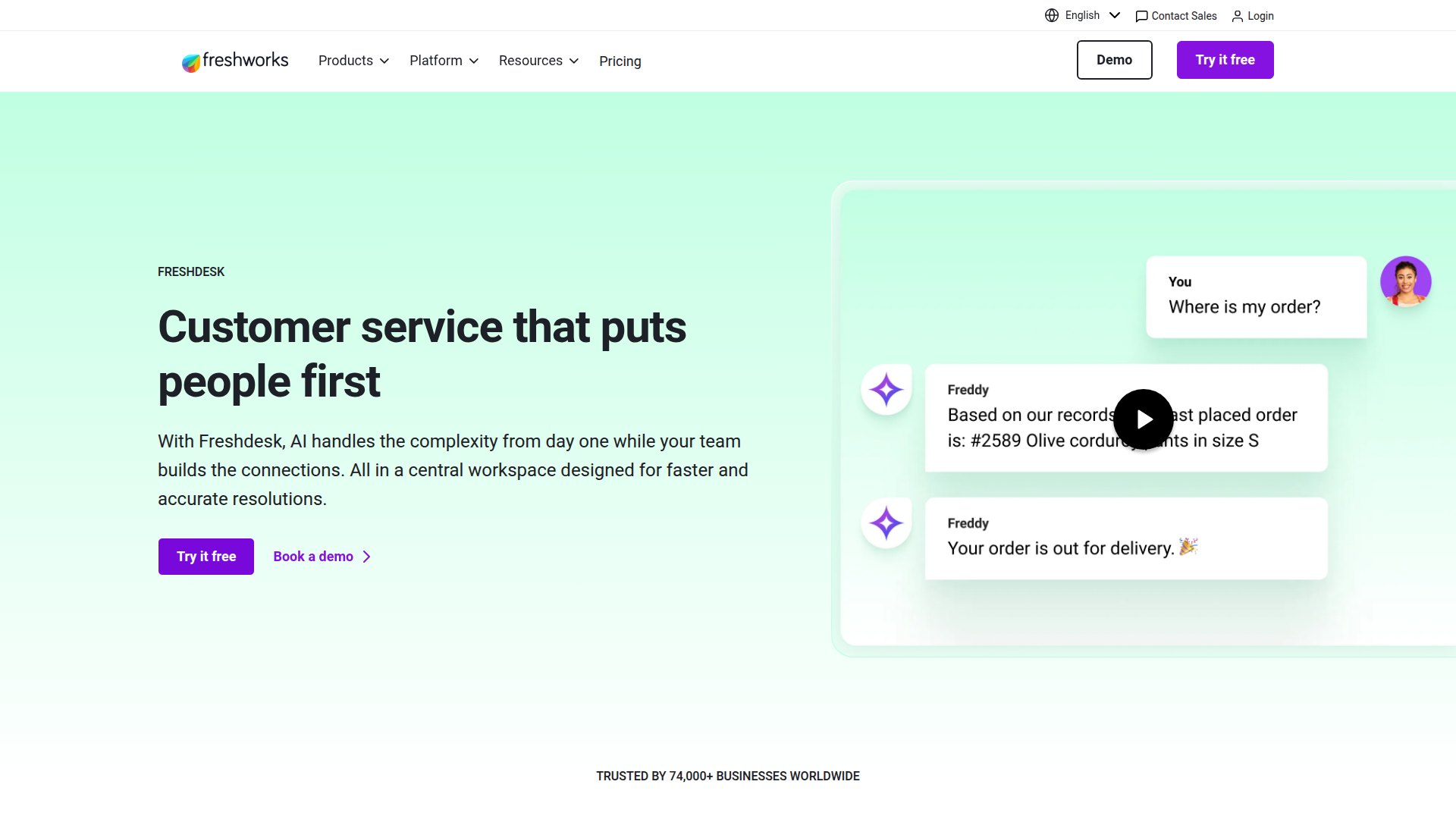
Pricing: Free for up to 10 agents. Paid plans start at $15/month per agent.
Freshdesk's free tier is legitimately good — email ticketing, knowledge base, and support for up to 10 agents. That's enough to handle early-stage customer support without spending a dollar. The paid tiers add automation, SLA management, and better reporting, but you can survive on the free plan longer than most competitors.
The interface feels a bit dated compared to newer tools like Crisp, and the mobile apps are occasionally buggy. But the core ticketing system is solid, and Freshworks (the parent company) has been around since 2010, so you're not betting on a startup that might disappear.
What We Liked
- Generous free tier (10 agents, unlimited tickets)
- Knowledge base included on free plan
- Decent automation on paid tiers
- Multi-channel support (email, phone, chat, social)
What Could Be Better
- UI feels dated compared to modern alternatives
- Mobile app occasionally crashes
- Advanced features require Growth plan ($49/agent/month)
Growth Hacker Take: Solid choice if you need to support a slightly larger team (6-10 agents) without paying per-seat costs. The free tier is more generous than Zendesk or Help Scout, but less feature-rich than Crisp. It works, but it won't wow you.
Freshdesk Setup & Features
External resources: Freshdesk Pricing | Capterra Reviews (4.5/5)
7. Drift — Best for B2B Sales Teams
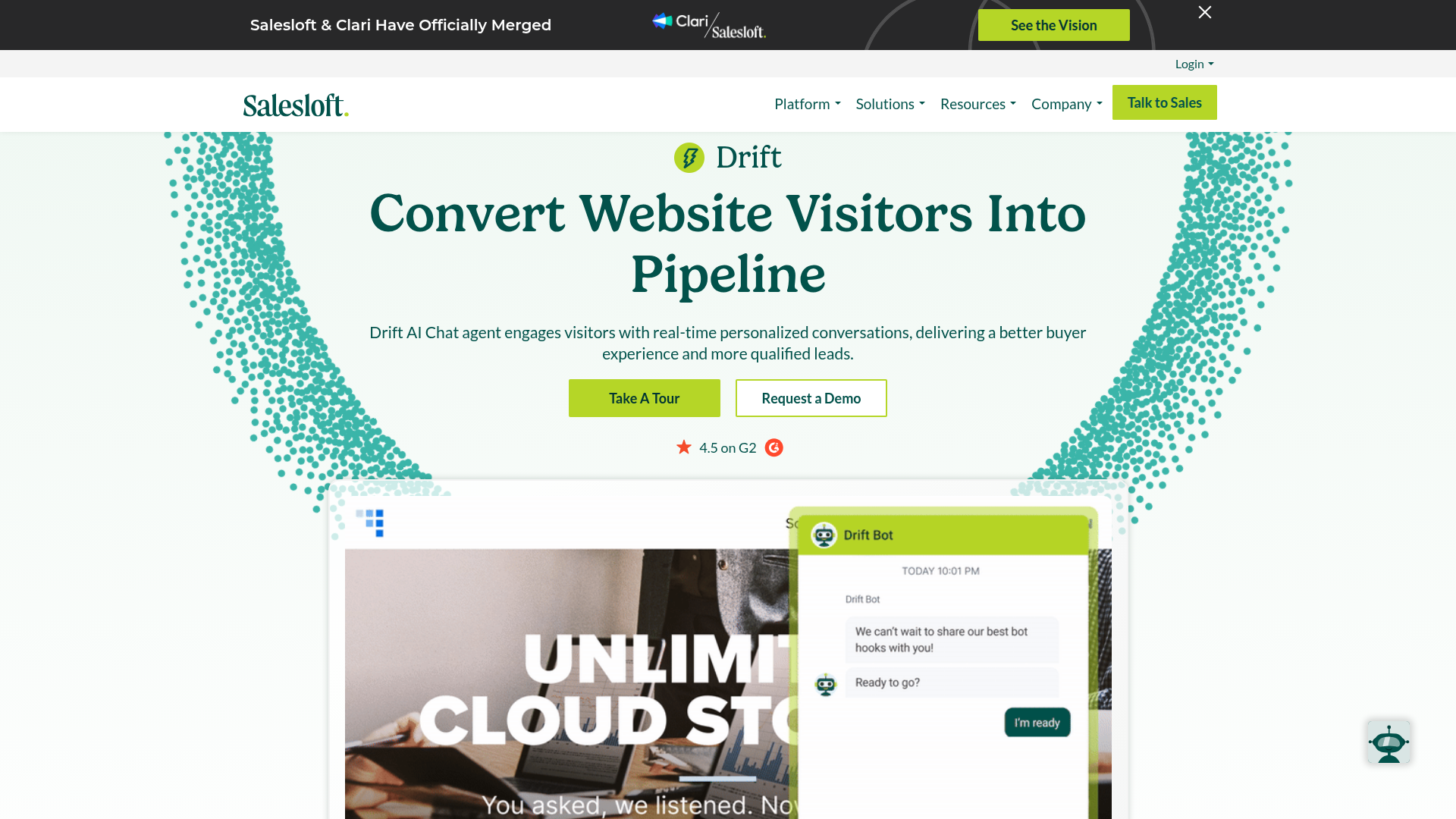
Pricing: Starts at $2,500/month (yes, seriously).
Drift is technically a live chat tool, but it's really a sales enablement platform disguised as customer support software. The focus is conversational marketing — qualifying leads, booking meetings, and routing high-value prospects to sales reps in real-time.
The pricing reflects this. At $2,500/month minimum, Drift is targeting B2B companies with long sales cycles and high contract values. If your average customer is worth $50K+, the math works. If you're selling $29/month SaaS subscriptions, look elsewhere.
What We Liked
- Powerful lead qualification and routing
- Native integration with Salesforce and HubSpot
- AI chatbots optimized for sales conversations
- Meeting scheduler built-in
What Could Be Better
- Absurdly expensive ($2,500/month starting price)
- Support features are secondary to sales
- Overkill for most use cases
Growth Hacker Take: Only consider Drift if you're in B2B enterprise sales and already spending $10K+/month on other tools. The sales automation is genuinely impressive, but the pricing model assumes you're closing five-figure deals. For actual customer support, almost any other tool on this list is better value.
External resources: Drift Pricing | G2 Reviews (4.4/5)
8. Help Scout — Best for Email-First Support
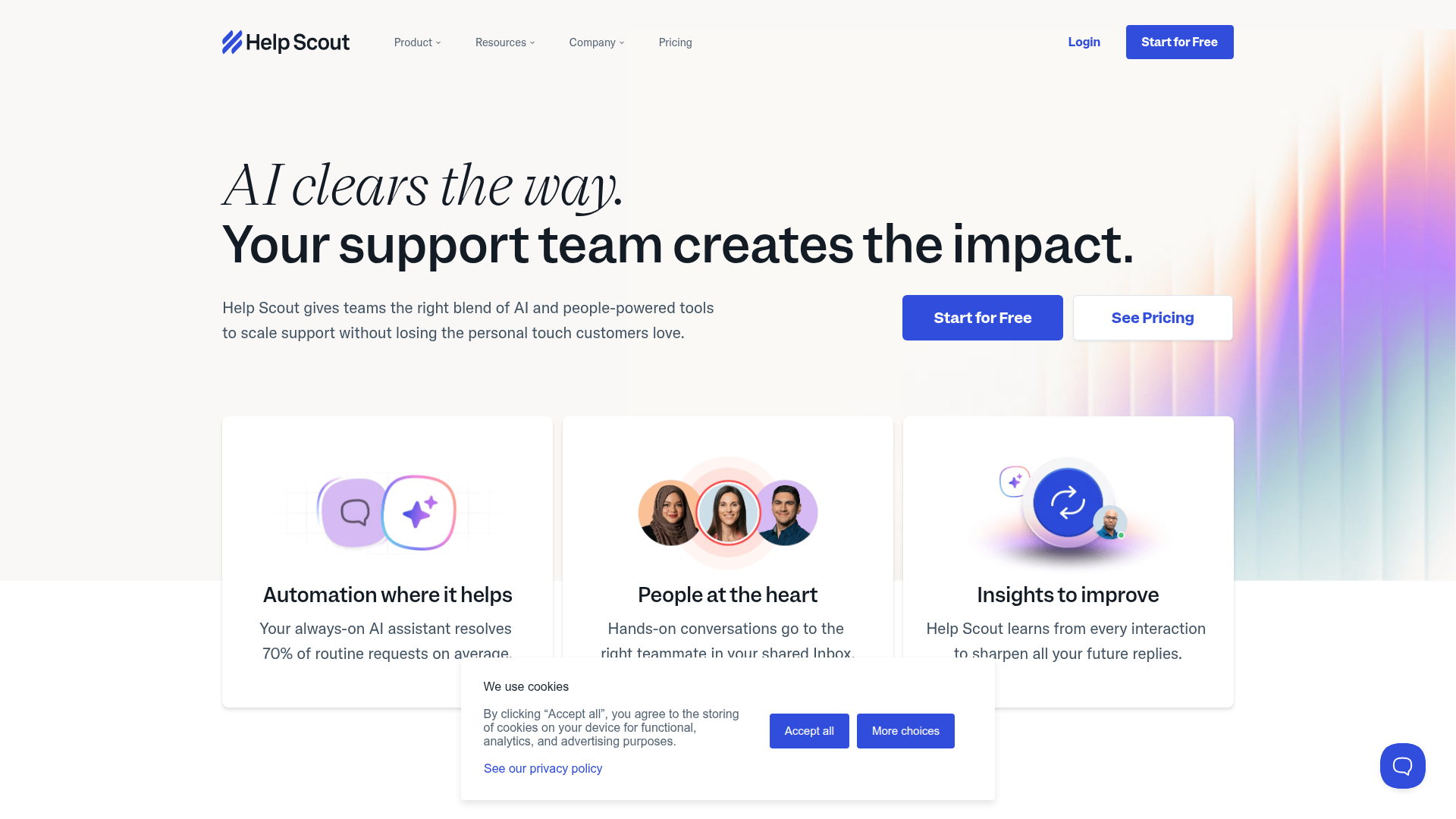
Pricing: Starts at $20/month per user (Standard plan).
Help Scout is what happens when you take a shared email inbox and add just enough features to make it a proper help desk. The interface is clean and email-centric — if your support team lives in Gmail, Help Scout will feel immediately familiar.
The downside is limited automation compared to Zendesk or Crisp. You get basic workflows and canned responses, but complex routing rules or AI-powered suggestions require manual setup. It's best for teams that prioritize human responses over chatbot automation.
What We Liked
- Beautiful, intuitive interface
- Collision detection (prevents duplicate responses)
- Customer profiles with conversation history
- Docs site builder included
What Could Be Better
- Limited automation compared to competitors
- No built-in live chat (requires third-party app)
- Reporting less detailed than Zendesk
Growth Hacker Take: Perfect for teams that do 90% of support over email and value simplicity over feature bloat. The interface is genuinely pleasant to use, which matters when your team is spending 6+ hours a day in it. But if you need omnichannel support or heavy automation, look at Crisp or Zendesk instead.
External resources: Help Scout Pricing | G2 Reviews (4.4/5)
How to Choose the Right Intercom Alternative
Picking a customer support tool isn't about features — it's about pricing model, team size, and where you'll be in 12 months. Here's how to narrow it down:
- Choose Crisp if: You need AI chatbots, omnichannel support, and unlimited agents without breaking the bank. Best all-around value for startups.
- Choose Tidio if: You're running e-commerce or have predictable support volume under 500 conversations/month. Great chatbot builder at a fair price.
- Choose Zendesk if: You're managing 1,000+ tickets per month, need enterprise SLAs, or have complex routing requirements. Worth the premium once you scale.
- Choose Chatwoot if: You have technical resources and want full data control. Open-source means no vendor lock-in and zero per-seat costs if self-hosted.
- Choose HubSpot Service Hub if: You're already using HubSpot CRM and need support data integrated with sales and marketing. The ecosystem value is real.
- Choose Freshdesk if: You need to support 10 agents on a free plan. More generous free tier than most competitors, though the UI shows its age.
- Choose Help Scout if: Your team lives in email and you value interface design. Perfect for email-first support with minimal automation needs.
Red flags to avoid: Per-seat pricing that punishes team growth, essential features locked behind "enterprise" tiers, conversation limits that reset monthly (looking at you, Intercom), and tools that charge separately for AI/automation add-ons.
Frequently Asked Questions
Is Intercom still worth using in 2026?
Only if you're enterprise-scale (500+ employees) and already locked into their ecosystem. For startups and scale-ups, the pricing is punitive — $74/month per seat adds up fast, and they charge extra for basic features like product tours. Most teams save 50-70% switching to alternatives like Crisp or Zendesk without losing functionality.
What's the cheapest Intercom alternative with good features?
Crisp offers the best value — free tier with unlimited agents, AI chatbots included, and paid plans starting at $25/month (not per seat). Tidio is also solid at $29/month if you need strong e-commerce features. Both are 70%+ cheaper than Intercom with comparable feature sets.
Do I need a dedicated help desk or is live chat enough?
Depends on support volume. Under 50 conversations/week, live chat with basic ticket tracking (like Crisp or Tidio) is fine. Over 200 tickets/week, you'll want proper help desk features — ticket assignment, SLA tracking, automated routing. That's when Zendesk or Freshdesk make sense.
Can I use these tools for customer success, not just support?
Yes, but some are better than others. Crisp and HubSpot Service Hub have proactive messaging and customer health tracking. Zendesk requires add-ons for customer success features. Help Scout is support-only. If customer success is primary, consider dedicated tools or platforms with built-in lifecycle management.
What about data privacy and GDPR compliance?
All tools on this list claim GDPR compliance, but implementation varies. Chatwoot (self-hosted) gives you complete data control. Crisp and Zendesk have EU data centers. HubSpot and Freshdesk are US-based but have EU hosting options. If you're serving EU customers or in a regulated industry, verify data residency options before committing.
How hard is it to migrate from Intercom?
Easier than expected. Most alternatives offer CSV import for contacts and conversation history. The painful part is rebuilding automation workflows and training your team on a new interface (budget 2-4 weeks). Crisp and Zendesk have dedicated migration support. Chatwoot requires more manual work but has community-built migration scripts on GitHub.
Bottom line: Intercom built a great product, then priced themselves out of the startup market. The alternatives listed here offer 80-100% of Intercom's features at 30-50% of the cost. Start with Crisp if you're unsure — the free tier is genuinely functional, and you can always upgrade or switch later. Your CFO will thank you.
About the Author
Marco Delvane
Growth Team at Vibe Growth Stack. Tested 100+ growth tools so you don't have to. Writes about what actually works for startups — no fluff, no affiliate bias.
More in this series
View full guide →Best Drift Alternatives 2026: 7 Live Chat Tools
Compare top Drift alternatives including Intercom, Crisp, Chatwoot & more. Find the best live chat and chatbot tool for your team in 2026.
7 Best Zendesk Alternatives in 2026 | Help Desk Tools
Compare top Zendesk alternatives for 2026. Discover 7 better help desk software options with lower pricing, easier setup, and superior features for customer support.
Best Freshdesk Alternatives 2026: Top Support Tools
Discover the best Freshdesk alternatives for 2026. Compare help desk software, ticketing systems, and customer support tools that actually work.
Related Articles
Get growth tips in your inbox
No-BS growth hacks, tool reviews, and best-value picks. Weekly.
Unsubscribe anytime. We hate spam too.