Apollo vs ZoomInfo 2026: Which B2B Data Tool Wins?
Compare Apollo and ZoomInfo B2B data tools. Discover which sales intelligence platform offers better value, data quality, and ROI for your sales team.

Marco Delvane
Growth Team
Key Takeaways
- Apollo wins on value: $49/user/month gets you database + outreach + CRM. ZoomInfo starts at $14,995/year with opaque pricing.
- ZoomInfo wins on data depth: Better intent data, technographics, and enterprise-grade accuracy for large deal cycles.
- Database size is overrated: Apollo's 275M contacts vs ZoomInfo's 260M doesn't matter. Coverage in YOUR ICP matters.
- Most teams pick Apollo: Unless you're selling $100K+ deals to Fortune 500, Apollo's price-to-value ratio crushes ZoomInfo.
- Hybrid approach wins: Use Apollo for volume outreach, Clay for waterfall enrichment across multiple sources including ZoomInfo data.
Why This Comparison Matters in 2026
The Apollo vs ZoomInfo debate isn't new, but it's hitting different in 2026. Apollo crossed 275 million contacts and keeps adding features (conversation intelligence, visitor tracking, AI message writing). ZoomInfo acquired Chorus and RingLead, building an end-to-end revenue platform. Both claim to be "all-in-one sales intelligence platforms."
But here's what nobody tells you: they serve fundamentally different customer profiles. Apollo targets scrappy startups and SMBs. ZoomInfo targets enterprise sales teams with six-figure budgets. The "best" tool depends entirely on your deal size, team structure, and whether you value flexibility or compliance.
This comparison uses real pricing data, G2 reviews from 15,000+ users, and insights from companies running $2M-15M ARR using both platforms. No vendor-sponsored fluff. Just tactical intelligence on which tool actually wins for YOUR use case.

Quick Comparison Table
| Feature | Apollo | ZoomInfo |
|---|---|---|
| Starting Price | Free (unlimited email) | $49/user/month | ~$14,995/year (contact sales) |
| Database Size | 275M contacts, 73M companies | 260M+ profiles, 135M phones |
| Email Accuracy | ~87% (G2 reviews) | ~90-92% (G2 reviews) |
| Free Plan | Yes (unlimited email credits) | No |
| Built-in Outreach | Multi-touch sequences included | Via Salesflow (separate module) |
| Intent Data | Via Bombora integration | Native Streaming Intent |
| G2 Rating | 4.8/5 (7,000+ reviews) | 4.4/5 (8,000+ reviews) |
| Best For | Startups, SMBs, volume outbound | Enterprise, compliance-heavy industries |
| VGS Verdict | Best value for 95% of teams | Worth it only for $100K+ ACV deals |
Apollo.io Full Review & Tutorial
1. Apollo.io — The All-in-One Value Play
Pricing: Free (unlimited email credits, 50 mobile credits) | Basic ($49/user/month) | Professional ($79/user/month) | Organization ($119/user/month)
Apollo packages database access, enrichment, email/LinkedIn sequences, call recording, and a CRM into one platform. The free plan gives unlimited email credits, making it absurdly generous for bootstrapped teams. The "Living Data Network" crowdsources corrections from 600K+ users, keeping data fresh. Real-time visitor tracking via Bombora integration adds intent signals without buying separate tools.
What We Liked
- Generous free plan beats every competitor (unlimited email credits)
- All-in-one approach eliminates tool sprawl (database + sequences + CRM + dialer)
- 95% email accuracy claim with "Living Data Network" crowdsourced corrections
- Chrome extension for one-click prospecting from LinkedIn/company websites
What Could Be Better
- Data extraction limits frustrate power users (especially on lower tiers)
- Customer support response times lag according to G2 reviews
- Single database means no waterfall enrichment like Clay offers
Growth Hacker Take: Apollo wins for teams under $5M ARR running volume outbound. The free plan alone replaces $200+/month in tools. But if you need 90%+ email accuracy for $50K+ deals, invest in ZoomInfo or use Clay to waterfall multiple sources.
2. ZoomInfo — The Enterprise Data Fortress
Pricing: Contact sales (~$14,995/year estimated starting point, often $30K-50K+ for full platform)
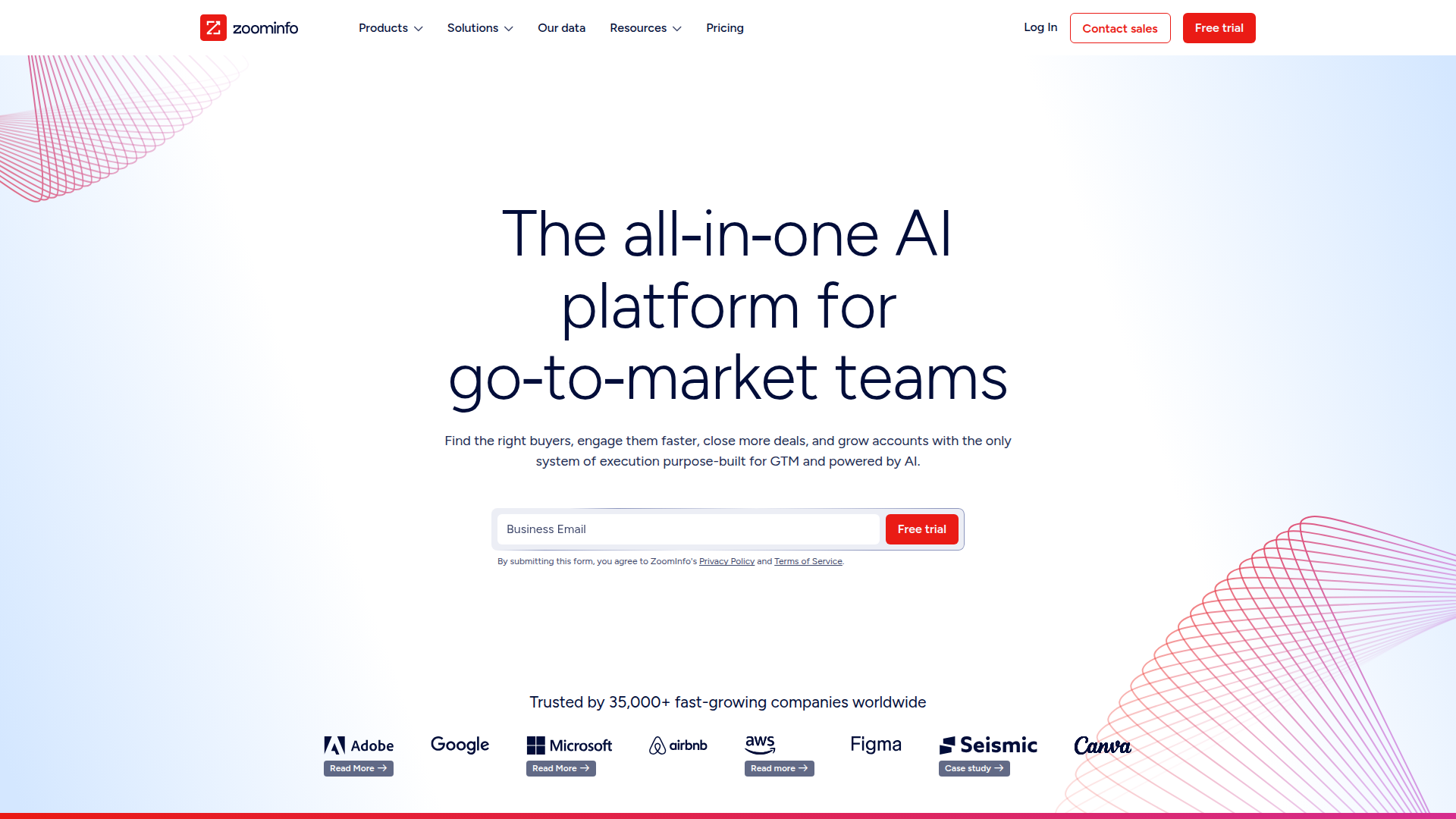
ZoomInfo targets enterprise sales organizations selling $100K+ deals to Fortune 5000 accounts. The platform combines contact database, Streaming Intent (real-time buying signals), technographic data (software usage), org charts, and compliance tools (GDPR, CCPA, DNC lists). ZoomInfo Copilot adds AI-powered conversation intelligence. Integration depth with Salesforce and Outreach makes it the RevOps team's choice for complex deal cycles.
What We Liked
- Streaming Intent catches buying signals before competitors (job postings, tech installs, web activity)
- Technographic data reveals software stack (critical for selling dev tools, martech, infrastructure)
- Compliance tools handle GDPR, CCPA, DNC automatically (required for regulated industries)
- Org chart mapping shows reporting structures for multi-threaded enterprise deals
What Could Be Better
- Pricing opacity wastes weeks in sales cycles (no public pricing, requires demos)
- Annual contracts lock you in (can't test monthly like Apollo or Instantly)
- Steep learning curve requires dedicated admin (not plug-and-play like Apollo)
Growth Hacker Take: ZoomInfo justifies its cost only if you're selling $100K+ ACV to enterprise accounts where intent data and technographics directly shorten 6-12 month sales cycles. For everyone else, the 3-5x price premium over Apollo doesn't return proportional value.
ZoomInfo Platform Walkthrough
Data Accuracy: The Real Story Nobody Tells You
Here's what matters more than vendor claims: accuracy varies wildly by segment. ZoomInfo crushes Apollo for Fortune 500 contacts because enterprise buyers update LinkedIn religiously and IT departments maintain org charts. Apollo wins for SMB and mid-market because its crowdsourced network catches job changes faster than manual research teams.
The numbers from G2 reviews:
- Apollo users report 85-90% email accuracy, 70-75% phone accuracy
- ZoomInfo users report 90-93% email accuracy, 85-90% phone accuracy
- Both platforms struggle with mobile numbers (60-70% accuracy across the board)
But here's the thing: no single database covers 100% of contacts. ColdIQ and other growth agencies use Clay to run waterfall enrichment across Apollo, ZoomInfo, Prospeo, and FullEnrich simultaneously. This approach delivers 95%+ coverage by trying multiple sources sequentially.
Waterfall enrichment example:
- Search Apollo first (cheapest per credit)
- If no email found, try ZoomInfo
- If still missing, try Prospeo (strong EU coverage)
- Final fallback: FullEnrich (15+ sources)
This strategy costs more per contact but eliminates the "sorry, we don't have that person" frustration that kills prospecting momentum.
Built-in Outreach: Apollo's Secret Weapon
Apollo includes multi-touch sequences (email + LinkedIn + calls) in all paid plans starting at $49/month. You can build a 10-step sequence mixing emails, LinkedIn connection requests, InMails, and call tasks without buying Outreach ($100+/user/month) or Salesloft ($125+/user/month).
ZoomInfo's outreach happens through Salesflow, a separate module that costs extra. Most ZoomInfo customers pair it with dedicated engagement platforms like Outreach, Salesloft, or Instantly for email. This adds $1,200-1,500/user/year to total cost.
For bootstrapped teams, Apollo's all-in-one approach eliminates $3K-5K/year in tool costs. For enterprise teams already committed to Outreach + Salesforce, ZoomInfo integrates more deeply with those existing investments.
Intent Data: Where ZoomInfo Actually Wins
ZoomInfo's Streaming Intent monitors 120M+ companies across 20,000+ topics, catching signals like:
- Website visits and content downloads
- Job postings (hiring SDRs = need for sales tech)
- Software installations (detected via browser plugins and network activity)
- Funding announcements and leadership changes
Apollo partners with Bombora for intent data but doesn't own the infrastructure. The integration works, but ZoomInfo's native Streaming Intent updates in real-time vs. Bombora's weekly batches.
When intent data matters: If you're selling sales enablement software and a company posts 5 SDR roles on LinkedIn while their existing team visits your pricing page, that's a qualified signal worth $100+ ACV. ZoomInfo surfaces this instantly. Apollo + Bombora surfaces it within 3-5 days.
For $10K-50K deals, that timing difference doesn't matter. For $500K+ enterprise deals with 3-month decision cycles, being first to the conversation changes win rates.
Integration Ecosystem: ZoomInfo's Depth vs Apollo's Breadth
Both platforms integrate with major CRMs (Salesforce, HubSpot, Pipedrive) and engagement tools (Outreach, Salesloft). The difference is depth:
Apollo: 200+ integrations via Zapier, native APIs, and webhooks. Works with modern stacks including Clay, Instantly, lemlist. Easy to connect with no-code tools.
ZoomInfo: 70+ native integrations built by dedicated integration engineers. Deep Salesforce sync (bi-directional field mapping, automated enrichment, activity logging). Certified partnerships with Outreach, Salesloft, 6sense.
If you run Salesforce + Outreach + 6sense and need everything syncing in real-time, ZoomInfo's enterprise-grade integrations justify the cost. If you're using HubSpot + Instantly + Clay, Apollo's API flexibility and lower price point win.
Pricing Breakdown: The 5-Year Cost Reality
Let's compare 5-year total cost of ownership for a 10-person sales team:
Apollo Professional ($79/user/month):
- Year 1: $9,480 (10 users × $79 × 12 months)
- 5-Year Total: $47,400
- Includes: Database, sequences, CRM, dialer, analytics
ZoomInfo Advanced (~$25,000/year estimated):
- Year 1: $25,000 (base platform)
- Add Salesflow: +$5,000/year
- Add Chorus (conversation intelligence): +$10,000/year
- 5-Year Total: $200,000+
- Still requires separate CRM and engagement tools
The $150K+ difference over 5 years funds:
- 2 additional SDRs at $60K salary
- Or LinkedIn ads budget ($30K/year)
- Or Clay + Instantly + lemlist stack with credits to spare
ZoomInfo makes sense when that $150K generates $500K+ in incremental revenue through better data accuracy and intent signals. For most teams, it doesn't.
How to Choose Between Apollo and ZoomInfo
Stop overthinking vendor feature matrices. Your decision comes down to three variables: deal size, team maturity, and budget flexibility.
- Choose Apollo if: You're selling to SMBs/mid-market ($5K-50K ACV), running volume outbound (100+ emails/day), operating on startup budgets, or need to test quickly without annual contracts
- Choose ZoomInfo if: You're selling enterprise deals ($100K+ ACV), targeting Fortune 5000 accounts, require GDPR/CCPA compliance tools, already run Salesforce + Outreach, or intent data + technographics directly shorten sales cycles
- Choose Clay + waterfall if: You need maximum data coverage (95%+), want to cherry-pick data from multiple sources, build custom workflows, or prioritize flexibility over convenience
Most teams under $10M ARR pick Apollo and never look back. Teams over $50M ARR with dedicated RevOps often justify ZoomInfo's cost through improved enterprise deal velocity.
FAQ
Is Apollo more accurate than ZoomInfo?
No. ZoomInfo reports 90-93% email accuracy vs Apollo's 85-90%, but the gap matters mainly for enterprise accounts. For SMB/mid-market, Apollo's crowdsourced network often updates faster.
Can I use both Apollo and ZoomInfo together?
Yes, but it's expensive. Better approach: Use Clay to waterfall Apollo → ZoomInfo → other sources, paying only for contacts found.
Does ZoomInfo have a free trial?
No. ZoomInfo requires talking to sales and typically enforces annual contracts starting around $15K/year.
Which tool has better mobile phone numbers?
ZoomInfo edges ahead with 85-90% phone accuracy vs Apollo's 70-75%, but both struggle with mobile numbers (60-70% accuracy).
Can Apollo replace ZoomInfo for enterprise sales?
Maybe. If your deals don't require deep technographics or real-time intent data, Apollo Professional ($79/month) covers 80% of ZoomInfo's functionality at 10% of the cost.
How does Clay compare to Apollo and ZoomInfo?
Clay isn't a database—it's a data orchestration platform that lets you waterfall multiple sources (including Apollo and ZoomInfo) for maximum coverage. See our Clay review for details.
About the Author
Marco Delvane
Growth Team at Vibe Growth Stack. Tested 100+ growth tools so you don't have to. Writes about what actually works for startups — no fluff, no affiliate bias.
Related Articles
Get growth tips in your inbox
No-BS growth hacks, tool reviews, and best-value picks. Weekly.
Unsubscribe anytime. We hate spam too.