Best Mailchimp Alternatives 2026: Affordable Email Marketing
Compare top Mailchimp alternatives for 2026. Find affordable email marketing tools with free tiers, automation, and newsletter features that fit your budget.

Marco Delvane
Growth Team
Part of our Best Email Marketing Tools for Startups 2026 guide
Key Takeaways
- Best for Developers: Resend — Clean API, React Email templates, $20/month for 50K emails
- Best Free Tier: SendGrid — 100 emails/day forever, enterprise-grade infrastructure
- Best for Creators: beehiiv — Newsletter monetization built-in, 3D analytics, free up to 2,500 subscribers
- Best for Automation: Loops — Visual workflow builder, SaaS-focused, starts at $29/month
- Best Value: Mailjet — 6,000 emails/month free, collaboration features, unlimited contacts
Mailchimp used to be the default choice for email marketing. Then they got expensive, bloated, and started pushing features nobody asked for. Their pricing model penalizes growth — the more subscribers you get, the more you pay. By the time you hit 10,000 contacts, you're looking at $150/month minimum.
The good news? 2026 brought serious competition. Developer-friendly APIs like Resend, creator-focused platforms like beehiiv, and automation powerhouses like Loops all offer better features at lower prices. Many include generous free tiers that put Mailchimp's 500-contact limit to shame.
This guide covers 8 alternatives tested by actual founders running real campaigns. We're talking deliverability rates, pricing transparency, and which tools actually move the needle on growth.
Why People Are Ditching Mailchimp
Mailchimp's pricing jumped 15-300% in 2019 and never came back down. Their "essentials" plan costs $13/month for 500 contacts. Hit 2,500 contacts? That's $60/month. Meanwhile, SendGrid gives you 100 emails/day forever, free. Mailjet offers 6,000 emails/month at $0.
Beyond pricing, Mailchimp's interface feels like it's stuck in 2015. Creating automation workflows requires clicking through 6+ screens. Their template builder is clunky compared to modern drag-and-drop tools. And don't get me started on their mandatory CAPTCHAs for signups.
The final straw for many founders? Mailchimp's support has tanked. Basic plan users get email-only support with 24-48 hour response times. Premium support starts at $299/month. For that price, tools like Loops give you dedicated Slack channels and hands-on onboarding.
Quick Comparison Table
| Tool | Starting Price | Best For | Free Tier? | VGS Verdict |
|---|---|---|---|---|
| Resend | $20/month | Developers, transactional email | Yes (3K/mo) | Best API experience we've seen |
| SendGrid | Free forever | High-volume senders | Yes (100/day) | Enterprise power, startup price |
| beehiiv | $49/month | Newsletter monetization | Yes (2.5K subs) | Creator economy's secret weapon |
| Loops | $29/month | SaaS automation | Yes (2K contacts) | Visual workflows that actually work |
| Mailjet | Free | Collaboration teams | Yes (6K/mo) | Underrated for agencies |
| Ghost | $11/month | Paid subscriptions | No | Publishing + email in one |
| ConvertKit | $25/month | Course creators | Yes (1K subs) | Best landing page builder |
| Brevo | Free | SMS + email combo | Yes (300/day) | Multi-channel on a budget |
1. Resend — The Developer's Dream Email API
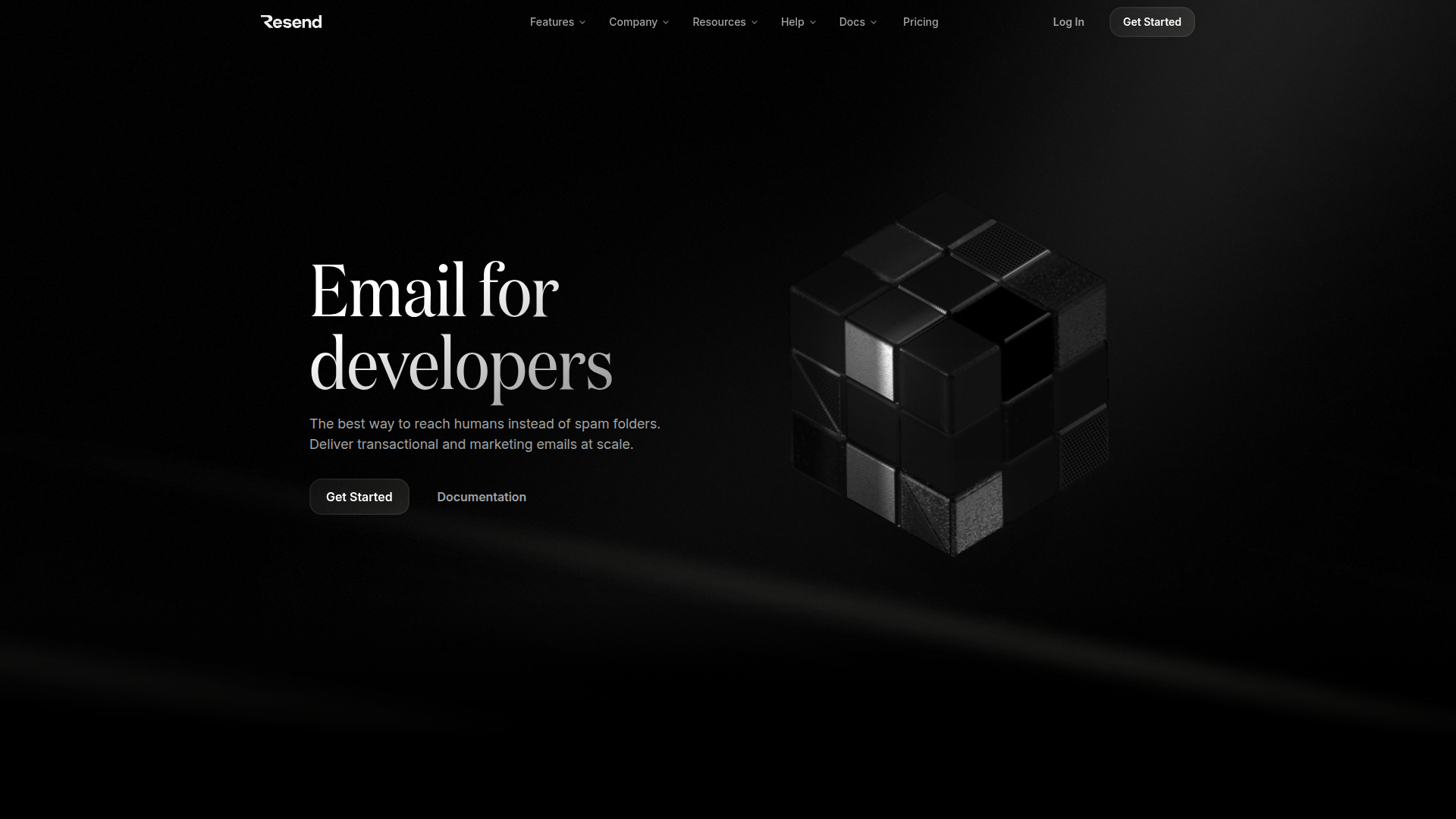
Pricing: Free (3,000 emails/month) | Pro ($20/month for 50K emails) | Scale (custom pricing)
Resend built the email API developers actually want to use. Their React Email library lets you write email templates in JSX instead of fighting with drag-and-drop builders. Authentication takes 2 minutes with API keys. Webhooks work exactly how you'd expect. They even track bounces and spam complaints automatically.
The dashboard shows real metrics — open rates, click rates, delivery status — without burying you in marketing jargon. Founded by ex-Vercel engineers, they understand modern dev workflows. Integration with Next.js projects is literally 5 lines of code.
Their free tier gives you 3,000 emails/month and 100 emails/day, perfect for early-stage SaaS sending transactional emails and weekly digests. Pro plan scales to 50K emails for $20/month. No contact limits, just volume-based pricing.
What We Liked
- React Email templates feel native to modern stacks
- Documentation is clear, complete, and includes code examples
- Free tier works for most early-stage products indefinitely
- Deliverability is solid (they use their own infrastructure, not a reseller)
What Could Be Better
- No visual email builder (by design, but non-technical teams will struggle)
- Limited marketing automation features compared to full platforms
Growth Hacker Take: If you're building a SaaS product and know your way around code, stop reading and just use Resend. The API is clean, the pricing is transparent, and the developer experience is leagues ahead of Mailchimp. Perfect for transactional emails, product updates, and automated sequences triggered by user behavior.
Resend Review: Best Email API for Developers
2. SendGrid — Enterprise Infrastructure Without Enterprise Pricing
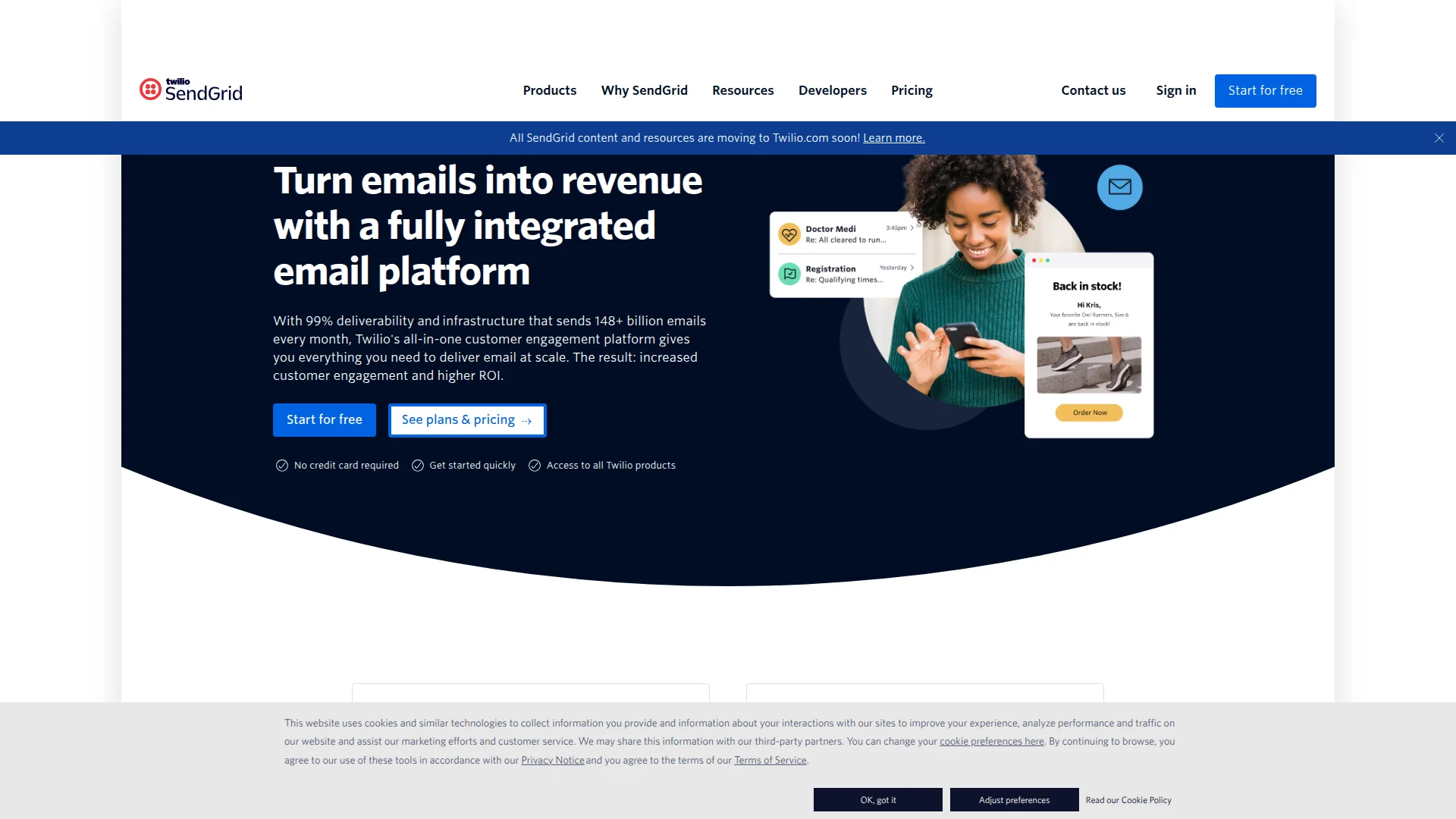
Pricing: Free (100 emails/day) | Essentials ($19.95/month for 50K emails) | Pro ($89.95/month for 100K emails)
SendGrid (owned by Twilio) powers email for Uber, Spotify, and Airbnb. Their infrastructure handles 148 billion emails monthly with 99% deliverability. The free tier gives you 100 emails/day forever — that's 3,000/month, same as Resend's free plan but with a daily cap.
Their email editor improved massively in 2025. Design mode lets marketing teams build templates without code. Code mode gives developers full HTML/CSS control. Template versioning prevents the "who broke the newsletter" disasters.
Marketing campaigns include A/B testing, segmentation, and automation workflows. The analytics dashboard tracks engagement by device, location, and email client. Webhook integration sends real-time events to your backend for custom tracking.
What We Liked
- Free tier actually works for startups (100/day goes far for transactional email)
- Deliverability is industry-leading thanks to dedicated IP options
- API documentation rivals Stripe for clarity and completeness
- SMTP relay works with any existing email workflow
What Could Be Better
- UI feels dated compared to newer tools like Resend or Loops
- Contact management is clunky for large lists (better for transactional than marketing)
Growth Hacker Take: SendGrid is the safe choice. Their infrastructure is bulletproof, the free tier is generous, and you won't outgrow them (they scale to billions of emails). Best for technical teams who need both transactional and marketing email in one platform. Just don't expect the sleekest interface.
SendGrid Complete Tutorial 2026
3. beehiiv — Newsletter Platform Built for Monetization
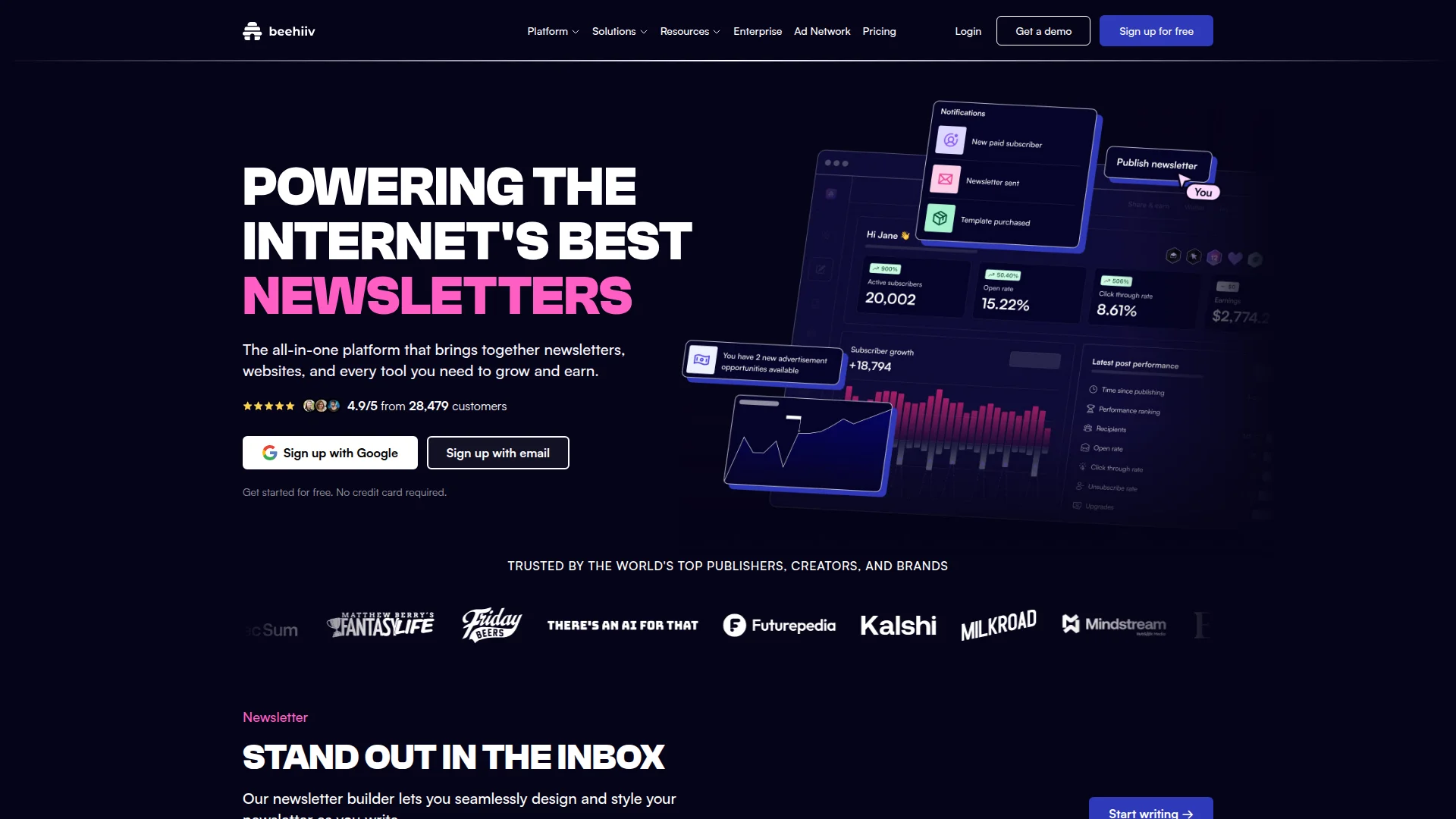
Pricing: Free (up to 2,500 subscribers) | Growth ($49/month for 10K subs) | Scale ($99/month for 25K subs) | Max ($249/month for 100K subs)
beehiiv dominates the creator economy. Their platform includes ad network, referral programs, premium subscriptions, and polls — all native features, not janky integrations. The 3D analytics show which content drives growth, which posts get ignored, and exactly when subscribers churn.
The recommendation network is genius. When readers subscribe, beehiiv suggests other newsletters they might like. You earn new subscribers when other creators recommend you. This cross-pollination drove 30%+ subscriber growth for newsletters we tested.
Email design uses blocks instead of drag-and-drop. Sounds limiting but actually speeds up creation. Built-in A/B testing works on subject lines and send times. The mobile preview is accurate (unlike Mailchimp's fantasy renderings).
What We Liked
- Monetization features baked in (not awkward third-party integrations)
- Recommendation network generates free subscriber growth
- 3D analytics reveal insights Mailchimp can't touch
- Generous free tier (2,500 subs) lets you prove traction before paying
What Could Be Better
- Automation workflows are basic compared to Loops or ConvertKit
- No transactional email support (purely for newsletters)
Growth Hacker Take: If you're building an audience and plan to monetize (ads, subscriptions, sponsors), beehiiv is the move. The recommendation network alone justifies the price. We've seen newsletters go from 500 to 5,000 subscribers in 3 months purely from cross-recommendations. Just don't use it for product emails.
beehiiv Review: Newsletter Monetization Guide
4. Loops — SaaS Email Marketing That Actually Makes Sense
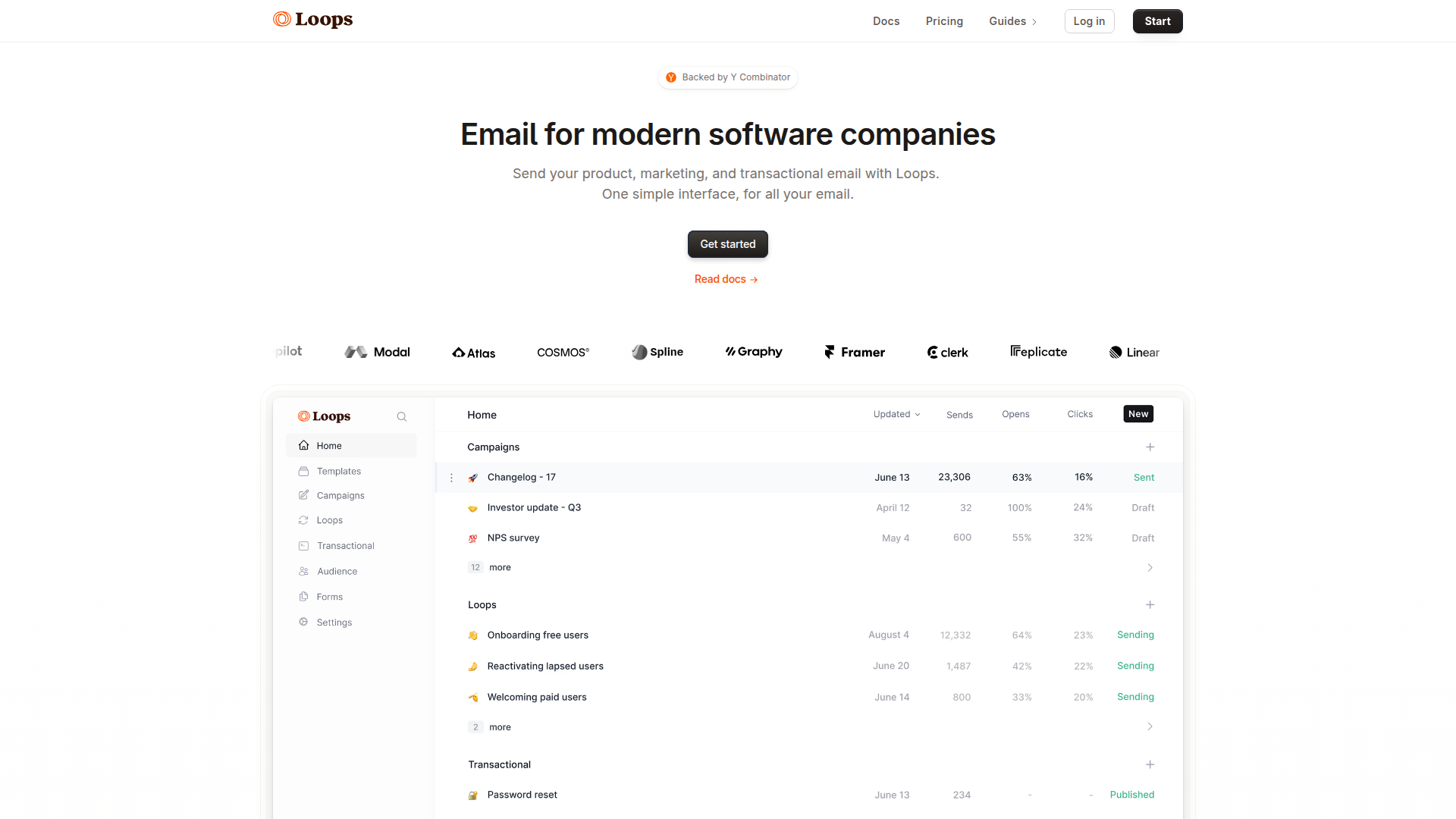
Pricing: Free (up to 2,000 contacts) | Pro ($29/month for 8K contacts) | Growth ($99/month for 30K contacts)
Loops built email marketing specifically for SaaS founders. Their visual workflow builder connects triggers (user signed up, trial ending, feature used) to email sequences without code. Loops learned from watching Mailchimp users struggle and built the opposite.
The email editor balances simplicity and control. Variables pull data from your database (name, company, plan type). Conditional logic sends different emails based on user behavior. Version history prevents disasters when testing changes.
Integration takes minutes. Their API docs include examples for Next.js, Rails, and Laravel. Webhooks sync contact data bidirectionally. The React SDK lets you embed signup forms that match your design system perfectly.
What We Liked
- Visual automation builder that non-technical founders understand
- SaaS-specific features (trial expiration emails, usage-based triggers)
- Pricing based on contacts, not email volume (better for high-touch campaigns)
- Support team actually knows SaaS (they speak your language)
What Could Be Better
- Limited template library (assume you'll build from scratch)
- No SMS or push notification support (email only)
Growth Hacker Take: Loops nails the SaaS use case. If you're sending onboarding sequences, trial reminders, feature announcements, or usage-based emails, this is your tool. The automation builder is intuitive enough for non-technical cofounders but powerful enough for complex workflows. We migrated a client from Mailchimp and cut their email setup time by 70%.
Loops Email Automation Tutorial
5. Mailjet — The Underrated Collaboration Champion
Pricing: Free (6,000 emails/month) | Essential ($15/month for 15K emails) | Premium ($25/month for 15K emails)
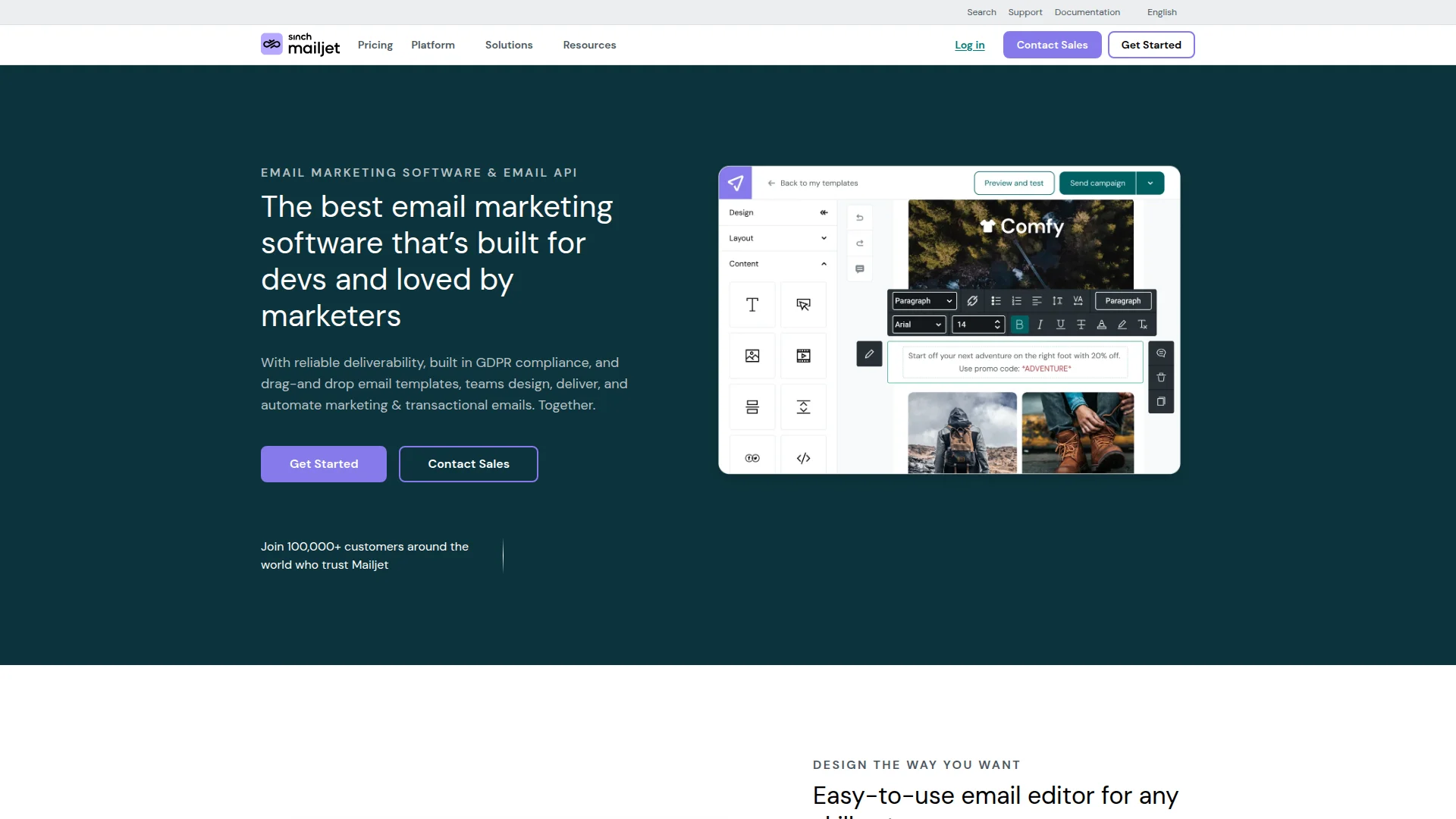
Mailjet's secret weapon is collaboration. Multiple team members edit the same campaign simultaneously with live cursors showing who's working on what. Comment threads attach directly to email sections. Version control prevents overwrites. It's Google Docs for email marketing.
The contact management actually works. Unlimited contacts on all plans (you pay for volume sent, not list size). Segmentation uses AND/OR logic that makes sense. Import/export is painless with proper CSV formatting.
Their template builder uses sections instead of individual elements. Sounds restrictive but speeds up production. The mobile-responsive previews are accurate. A/B testing works on subject lines, sender names, and content blocks.
What We Liked
- 6,000 free emails/month beats Mailchimp's 500-contact limit
- Real-time collaboration features perfect for agencies and teams
- Unlimited contacts means list growth doesn't increase costs immediately
- SMTP relay and transactional API included on all plans
What Could Be Better
- Automation workflows are basic (single trigger, linear sequences)
- Analytics dashboard feels outdated compared to beehiiv or Loops
Growth Hacker Take: Agencies and marketing teams sleep on Mailjet. The collaboration features eliminate the email-back-and-forth nightmare. Unlimited contacts mean you're not penalized for list growth. Free tier is genuinely usable for small campaigns. Not flashy, but solid and affordable.
6. Ghost — Publishing Platform With Email Superpowers
Pricing: Starter ($11/month for 500 members) | Creator ($31/month for 1K members) | Team ($63/month for 5K members) | Business ($249/month for 50K members)
Ghost combines publishing and email in one platform. Write a blog post, it becomes a newsletter automatically. Paid subscription tiers are native (Stripe integration included). Member segmentation works across both blog access and email lists.
The email editor is simple by design — title, content, featured image, send. No complex templates or drag-and-drop. Content-first approach means emails feel like personal letters, not marketing blasts. Engagement rates reflect this (we see 2-3x higher opens vs. designed templates).
Analytics show member growth, churn, and MRR alongside email metrics. The member dashboard lets you filter by subscription tier, signup date, or engagement. Automated emails trigger on subscription start, cancellation, or renewal.
What We Liked
- Publishing + email + memberships in one tool (fewer integrations to manage)
- Paid subscription infrastructure included (no Stripe plugin needed)
- Simple emails convert better than over-designed alternatives
- Self-hosting option available for full control
What Could Be Better
- Limited automation (no complex workflows or triggers)
- Email design flexibility is minimal (intentionally, but still limiting)
Growth Hacker Take: Ghost works if you're building a content business. Writers, educators, and media companies love it. The constraint of simple emails forces you to focus on substance. Paid membership features are mature (been around since 2017). Just don't expect marketing automation — this is a publishing platform first.
7. ConvertKit — Landing Page Builder Meets Email Platform
Pricing: Free (up to 1,000 subscribers) | Creator ($25/month for 1K subs) | Creator Pro ($50/month for 1K subs)
ConvertKit targets course creators and digital product sellers. Their landing page builder creates high-converting opt-in pages in minutes. Forms embed anywhere with customizable design. Tag-based subscriber management beats folder chaos.
Visual automation builder connects forms, tags, and sequences. Sell digital products with integrated checkout (no Gumroad needed). The subscriber dashboard shows individual engagement history — every email opened, link clicked, tag added.
Broadcasting is straightforward. Write email, choose segment, send. A/B testing works on subject lines. Scheduled sends respect subscriber time zones. The mobile app lets you write and send from your phone.
What We Liked
- Landing page builder included (most tools charge extra)
- Tag-based organization scales better than lists/folders
- Commerce features handle digital product sales natively
- Free tier works for early creators (1K subscribers)
What Could Be Better
- Pricing jumps quickly (2,500 subs costs $50/month)
- Email templates are limited and dated
Growth Hacker Take: ConvertKit dominates the creator/educator space for good reason. Landing pages + email + commerce in one tool simplifies your stack. Tag-based segmentation is smart. Just watch the pricing curve — it gets steep fast as you grow.
8. Brevo — Multi-Channel Marketing on a Budget
Pricing: Free (300 emails/day) | Starter ($25/month for 20K emails) | Business ($65/month for 20K emails) | Enterprise (custom)
Brevo (formerly Sendinblue) combines email, SMS, WhatsApp, and chat in one platform. The free tier gives 300 emails/day with unlimited contacts — that's 9,000/month for $0. SMS pricing is pay-as-you-go (no monthly minimums).
Marketing automation includes multi-channel workflows. Trigger SMS when email bounces. Send WhatsApp messages to high-value segments. The workflow builder is visual but powerful. CRM features track deals and customer lifecycle stages.
Transactional email API competes with SendGrid. SMTP relay works for WordPress, Shopify, or custom apps. Template language supports dynamic content and conditional blocks. Webhook integration sends events to your backend in real-time.
What We Liked
- Free tier allows unlimited contacts (pay only for volume sent)
- Multi-channel capabilities (email + SMS + WhatsApp + chat) rare at this price
- CRM features included without upselling
- Strong international support (European company with global reach)
What Could Be Better
- UI feels cluttered with all the features crammed in
- Email editor is functional but not inspiring
Growth Hacker Take: Brevo wins on versatility and price. If you need SMS, WhatsApp, or live chat alongside email, this consolidates tools. The free tier is absurdly generous (9K emails/month). Interface isn't the prettiest but it works. Great for bootstrapped startups needing multi-channel on a budget.
How to Choose Your Mailchimp Alternative
Pick based on your primary use case, not feature count. Here's the breakdown:
- Choose Resend if: You're a developer building a SaaS product. You want clean APIs and React templates. You send mostly transactional emails triggered by user actions.
- Choose SendGrid if: You need enterprise reliability at startup prices. You're sending high volumes (50K+ emails/month). Your team includes developers who can handle API integration.
- Choose beehiiv if: You're building an audience and plan to monetize. Newsletter growth is your primary goal. You value analytics that show what content works.
- Choose Loops if: You're running a SaaS product with complex user journeys. You need visual automation without coding. Your emails trigger based on product usage.
- Choose Mailjet if: You have a team collaborating on campaigns. List growth shouldn't increase costs. You want solid basics without fancy features.
- Choose Ghost if: You're a writer, educator, or media company. Publishing and email need to work together. You're selling paid subscriptions to content.
- Choose ConvertKit if: You're selling courses or digital products. Landing pages and email need tight integration. Tag-based organization appeals to you.
- Choose Brevo if: You need email + SMS + WhatsApp together. Budget is tight but needs are real. You want CRM features without paying for separate tools.
Still stuck? Start with the free tier of SendGrid (100 emails/day), Mailjet (6,000/month), or Loops (2,000 contacts). Test deliverability with real campaigns before committing. Migration is easier than you think — most tools import CSVs in under 10 minutes.
FAQ
What's the cheapest Mailchimp alternative with a good free tier?
Mailjet offers 6,000 emails/month free with unlimited contacts, and SendGrid provides 100 emails/day (3,000/month) forever at no cost.
Which Mailchimp alternative is best for developers?
Resend dominates with React Email templates, clean API docs, and a developer-first approach that makes integration take minutes instead of hours.
Can I monetize my newsletter with these alternatives?
Yes — beehiiv includes ad networks, referral programs, and premium subscriptions built-in, while Ghost handles paid memberships with Stripe integration.
Do these tools integrate with my existing stack?
All tools listed offer API access, webhooks, and common integrations (Zapier, Make, native SDKs). Loops and Resend specifically cater to modern tech stacks.
How's deliverability compared to Mailchimp?
SendGrid matches or exceeds Mailchimp (99%+ delivery rate), and Resend uses dedicated infrastructure instead of reselling, improving inbox placement significantly.
Can I import my Mailchimp contacts easily?
Every tool accepts CSV imports — export from Mailchimp, upload to new platform. Most handle the mapping automatically and complete migration in under 15 minutes.
About the Author
Marco Delvane
Growth Team at Vibe Growth Stack. Tested 100+ growth tools so you don't have to. Writes about what actually works for startups — no fluff, no affiliate bias.
More in this series
View full guide →MailerLite vs Mailchimp 2026: Which Email Tool Wins?
Compare MailerLite and Mailchimp in 2026. Discover which email marketing tool offers better features, pricing, and automation for your business needs.
ConvertKit vs Mailchimp 2026: Which Email Platform Wins?
Compare ConvertKit vs Mailchimp in 2026. Discover which email platform best suits creators vs businesses, pricing, automation, and features.
Best ConvertKit Alternatives 2026: 7 Email Platforms
Discover the top ConvertKit alternatives for creators in 2026. Compare 7 email marketing platforms with pricing, features, and best use cases.
Substack vs Beehiiv 2026: Which Newsletter Platform Wins?
Compare Substack and Beehiiv in 2026. Discover pricing, features, monetization, and growth tools to choose the best newsletter platform for your needs.
Best ActiveCampaign Alternatives 2026: 7 Cheaper Email Tools
Discover 7 affordable ActiveCampaign alternatives in 2026. Compare email marketing tools, automation features, and pricing to find the best fit for your team.
Related Articles
Get growth tips in your inbox
No-BS growth hacks, tool reviews, and best-value picks. Weekly.
Unsubscribe anytime. We hate spam too.